
Overview
- Advanced technology can improve the efficiency and accuracy of mapping, monitoring, and reporting for restoration projects
- But we must be confident that these tools are measuring real ecological and social outcomes
- The International Principles and Standards for the Practice of Ecological Restoration from the Society for Ecological Restoration (SER Standards) offer a robust and dynamic framework to support monitoring and verification
- The tools and guidelines within the Standards are flexible and adaptable, used across a wide variety of ecosystems and specialized applications around the world, including certification systems
- For example, The Global Biodiversity Standard (TGBS) is a trusted site-based assurance standard for biodiversity monitoring that uses SER’s Five-star System to interpret recovery data
- Case studies demonstrate the benefits and applicability of SER’s Standards to effectively measure the impact of restoration projects.
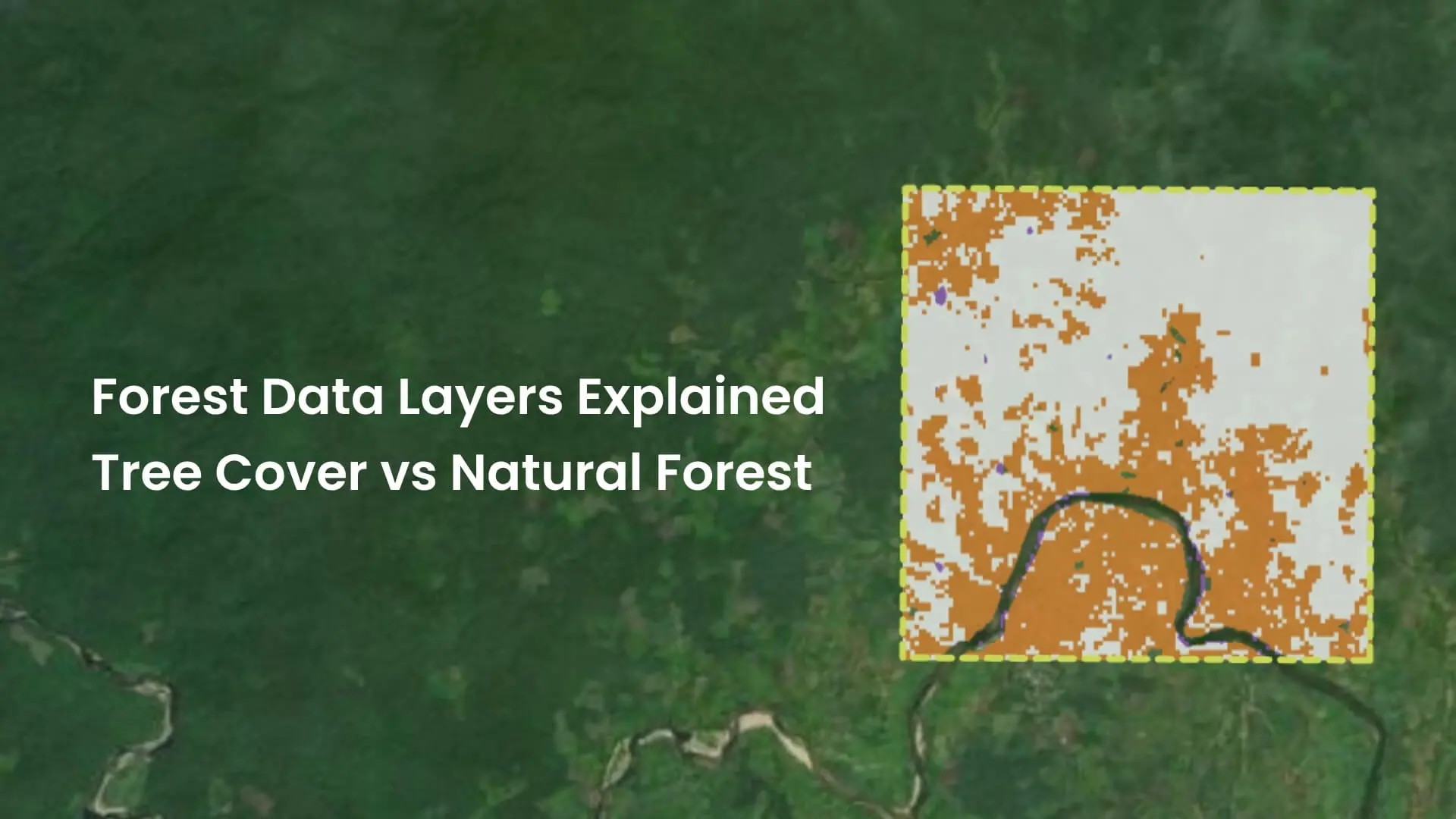
Sophisticated satellite imagery, drones, and other advanced monitoring and analysis tools and technologies enable us to almost instantly visualize data about a restoration site. Geo-transparency platforms like explorer.land have transformed how quickly and precisely we can see and analyze change on the ground. But we know that “outputs are not the same as outcomes”. To measure long-term impacts, we need a scientific basis that enables us to accurately and consistently measure progress and results against a rigorous and relevant baseline.
In June 2026, the Society for Ecological Restoration (SER) published the third edition of its International Principles and Standards for the Practice of Ecological Restoration (SER Standards). It is the most widely used scientific reference for restoration practice globally, and is a key document supporting the UN Decade on Ecosystem Restoration, Target 2 of the Kunming-Montreal Global Biodiversity Framework (KM-GBF). It also underpins the Global Biodiversity Standard (TGBS), used by organisations like Ecosia to provide independent, site-based biodiversity assessment and help funders make confident, defensible decisions about biodiversity outcomes.
Standards and tools for effective restoration
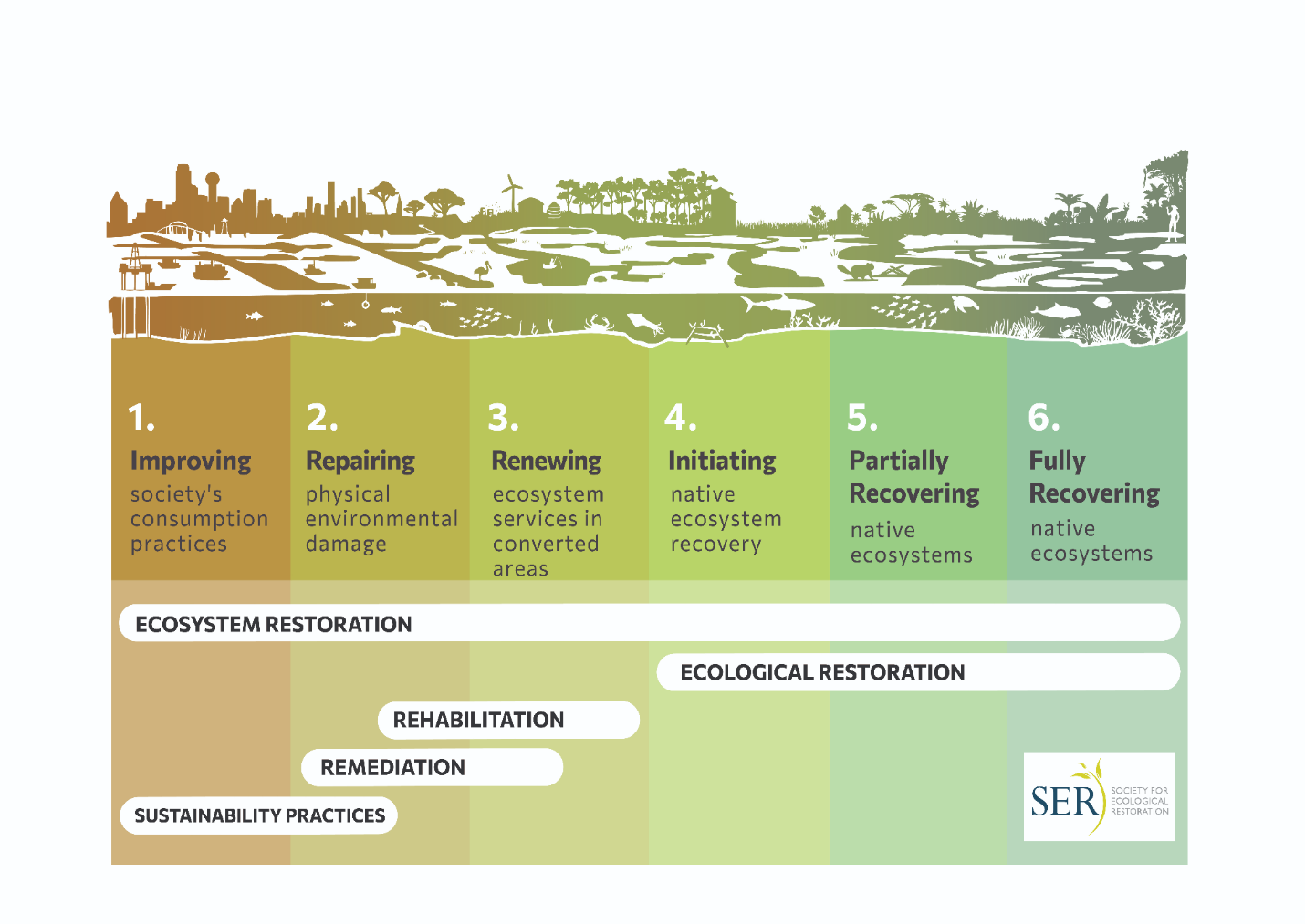
Ecological restoration sits on a continuum of restorative activities. This encompasses a wide range of restoration approaches, activities, and techniques, which can be applied depending on multiple factors, including but not limited to specific ecosystems, biomes, land or seascapes, the level of degradation, and the desired outcomes. The illustration indicates how the specific context and characteristics of sites influence the selection of activities.
Eight Principles to measure and guide restoration practice
The SER Standards are an adaptable framework based on eight important Principles that explain, define, guide, and measure the activities and outcomes of ecological restoration practice.
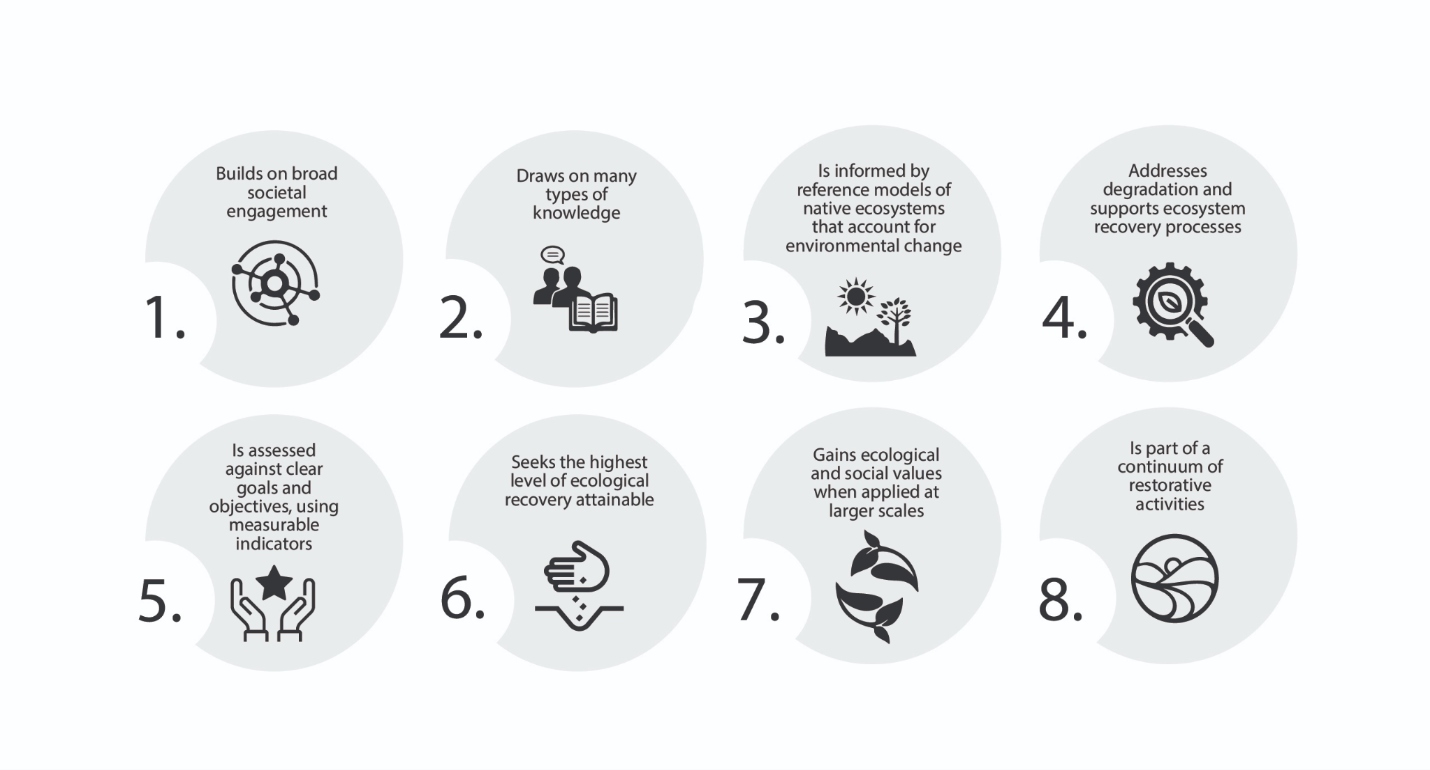
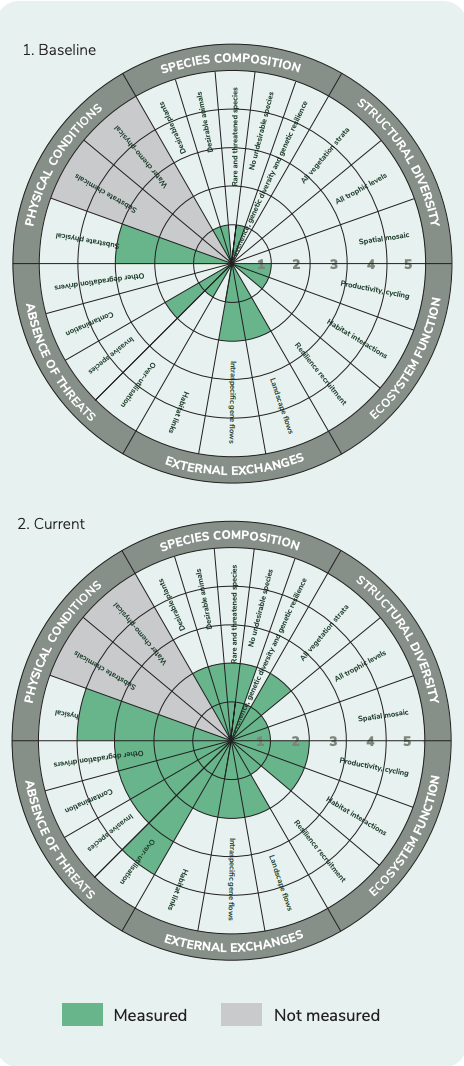
These key Principles are supported by flexible tools, including the Ecological Five-star System and the Ecological Recovery Wheel (ERW), that provide a relative scale to evaluate projects.
Together, they help managers, practitioners, and regulators establish, visualize, and communicate the level of ecological recovery aspired to, and to progressively evaluate and track the degree of native ecosystem recovery over time from the baseline condition toward these goals, always guided by a reference model.
For any given project, the Five-star System measures six key ecosystem attributes: absence of threats, physical conditions, species composition, structural diversity, ecosystem function, and external exchanges. Each attribute is underpinned by three or more sub-attributes, which can be tailored according to the ecosystem or project being assessed.
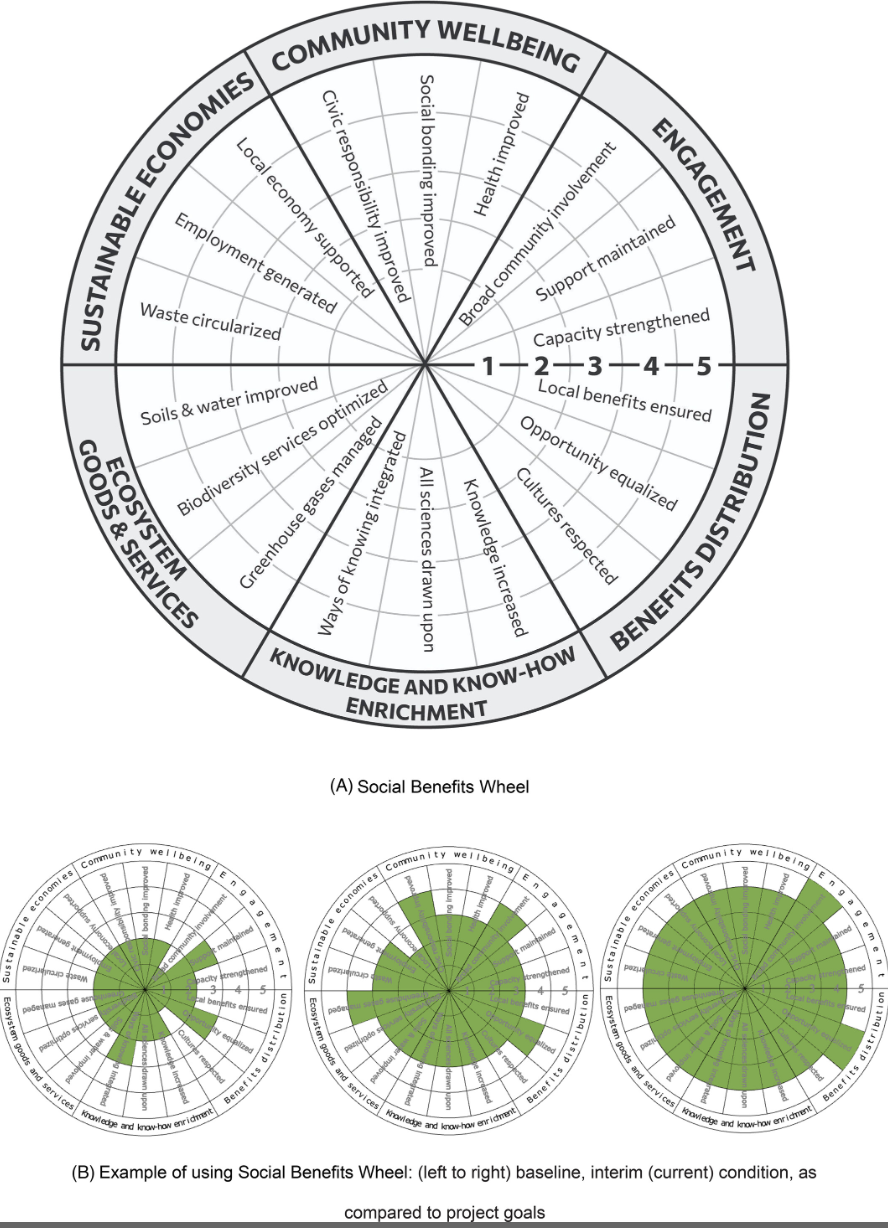
This system is equally applicable for social impacts. Under SER’s first two Principles, social goals must be identified alongside ecological goals during the planning stage of a restoration project. SER’s Social Benefits Wheel also uses star levels for six social attributes and related sub-attributes to track progress and impact.
Effective monitoring requires appropriate indicators
The Five-star System and Recovery Wheels have been increasingly adapted and used by practitioners and scientists for a wide variety of ecosystems and specialized applications around the world, including certification systems. This includes The Global Biodiversity Standard (TGBS), which was developed by a coalition of leading organisations, including SER, Botanic Gardens Conservation International, Ecosia, and the Plan Vivo Foundation, to provide a rigorous assessment of biodiversity outcomes. The Five-star System is used to interpret remote sensing signals together with on-site data, with the Five-star scale used to establish both a high-integrity and a highly degraded (0-star) reference condition and indicate whether sites are recovering toward a high-integrity state.
This rigorous certification ensures that projects are delivering ecological and social net gain in the long term. Even in cases where a project does not meet minimum standards, as occurred with this reforestation project in Madagascar, applying the SER Standards also delivers important feedback about areas for improvement, presenting a roadmap for future success and measurable impact.
Importance of a reference model (Principle 3)
The essential foundation for measuring the success of any restoration project is the establishment of a reference model against which progress is measured. Optimally developed from a number of reference sites and other data, they aim to define the condition of the ecosystem being restored in the absence of degradation – that is, a Five-star condition. Importantly, they are not intended to “immobilize” an ecosystem at a specific point in time but account for inherent changes over time due to both internal factors (such as biotic interactions) and external influences (such as climate and other disturbances). In marine ecosystems, for example, restoration outcomes depend on oceanographic and climatic drivers; therefore, reference models must integrate temperature, hydrodynamics, and salinity parameters. Investing in the development of a reference model is essential during the project planning phase and should be fully incorporated into timelines and budgets.
All projects applying for TGBS certification, for example, must begin by defining the baseline, which indicates the conditions of a site immediately before beginning an intervention, as compared to a reference model. This is indispensable for determining prior degradation, setting goals, and tracking progress over time to determine scoring for the project.
The Five-star System in action: Community-led restoration in the Budongo-Bugoma wildlife corridor, Uganda
Project overview
Since 2017, the Jane Goodall Institute (JGI) Uganda, in partnership with Ecosia, has conducted conservation and restoration work in the Budongo-Bugoma wildlife corridor in Uganda. Deforestation from urban and agricultural expansion, along with the impacts of climate change, have severely degraded ecosystems in the region, impacting biodiversity.
The project aimed to deliver social benefits through close stakeholder collaboration, including climate resilience and protection of livelihoods, alongside the restoration of vital ecosystems. The community-led tree-planting initiative resulted in over 2.4 million trees planted along the corridor, with a focus on addressing the underlying causes of degradation and increasing social-ecological resilience.
Measuring outcomes with TGBS and SER’s Five-star system
TGBS was used to assess the project. Assessors from Tooro Botanical Gardens in Uganda collected data to understand ecosystem integrity using a combination of field surveys, remote sensing, socio-economic surveys, and documentation review.
Assessors used four key frameworks, starting with ecosystem integrity, measured using SER’s Five-star system. In addition, the assessment looked at level of protection, stakeholder engagement and social benefits, and robust monitoring, evaluation, and adaptive management.
Analysis and certification
Based on the analysis of eight criteria, the project was awarded the TGBS Advanced Certification, with an overall score of 7.93 out of 10 for the site.
“The Budongo-Bugoma wildlife corridor project shows us the power of standards and certification,” said David Bartholomew, CEO of TGBS. ”It delivered substantial and durable impacts for biodiversity by empowering the local community and increasing its resilience through education, knowledge building, and diversification of livelihood opportunities. It is a powerful blueprint for the application of TGBS to guide and measure outcomes, making them replicable so we can accelerate and scale effective restoration in other contexts”.
Transparency to de-risk restoration projects
Transparency is increasingly valuable as demand for investment and capacity in restoration increases in response to targets set by the KM-GBF and regional policies like the EU’s Nature Restoration Regulation (NRR). In the insurance sector, for example, global reinsurer SCOR has developed a suite of ecological restoration insurance products that cover risks associated with ecological restoration projects. These solutions have been developed in collaboration with SER, using the SER Standards as a basis for assessing and grading project quality and insurability.
Conclusion
Significant advances in technology now enable us to capture and analyse huge quantities of data in vastly reduced timeframes. This offers tremendous opportunities for more effective planning, monitoring, and measurement of projects, to accelerate effective ecological restoration. SER’s Standards are the ‘industry standard’ for restoration, offering clarity and consistency to increase trust in project outcomes. They enable practitioners and project managers to assess data, ensuring that outcomes deliver the intended long-term impacts. They are not written to align with any one specific monitoring system, but are adaptable for use in different contexts to increase certainty and reduce risk in projects across any scale, ecosystem, or biome.
To learn more about the SER Standards and to download supporting tools, please visit www.ser.org/standards.
References
Bartholomew and Mosyaftiani et al. (2024). The Global Biodiversity Standard: Manual for assessment and best practices. BGCI, Richmond, UK & SER, Washington, D.C. USA. Accessed 09.01.26 at: https://cdn.ymaws.com/www.ser.org/resource/resmgr/docs/25.07.2024_TGBS_-_The_Global.pdf
Gann, G.D., McDonald, T., Walder, B., Aronson, J., Nelson, C.R., Hallett, J.G., Guariguata, M.R., Gonzales, E.K., Hua, F., Echeverria, C., Eisenberg, C., Liu, J., Decleer, K., Barr, Z.E., Bartholomew, D.C., Best, M., Chazdon, R., Cliquet, A., Cortina-Segarra, J., Kalirai, H., MacCallum, K., Mosyaftiani, A., Pedrini, S., Young, R., and Dixon, K.W. (2026). International principles and standards for the practice of ecological restoration. Third edition. Restoration Ecology https://onlinelibrary.wiley.com/doi/10.1111/rec.70441
The Global Biodiversity Standard (TGBS). (n.d.-a). News: Optimising project implementation and biodiversity gains through the Global Biodiversity Standard: evidence from a protected area in Southern Madagascar. Accessed 09.01.26 at: https://www.biodiversitystandard.org/2026/07/01/optimising-project-implementation-and-biodiversity-gains-through-the-global-biodiversity-standard-tgbs-evidence-from-a-protected-area-in-southern-madagascar/
The Global Biodiversity Standard (TGBS). (n.d.-b). Case study: Community-led restoration in the Budongo-Bugoma wildlife corridor in Uganda. Accessed 09.01.26 at: https://www-static.biodiversitystandard.org/wp-content/uploads/2025/06/TGBS-JGI-Advanced-Site-Case-Study-Medium-resolution.pdf?media=1647864625
SCOR. (n.d.). Nature conservation and restoration insurance initiative. P&C underwriting solutions. Accessed 09.01.26 at: https://www.scor.com/en/nature-restoration-conservation-insurance-initiative