Key Highlights
- Nature does not lack interest from investors; it is hard to underwrite because it is difficult to measure, monetise and price against the risks it prevents.
- The gap is structural: USD 351 billion per year is missing to reach 2030 targets, while USD 7.3 trillion still flows into activities that harm nature.
- Investors capture little of the upside of restoration and pay little of the downside of nature loss, so market signals point away from nature.
- Better monitoring makes projects more investable, but data alone cannot create a business model without risk-sharing financial structures.
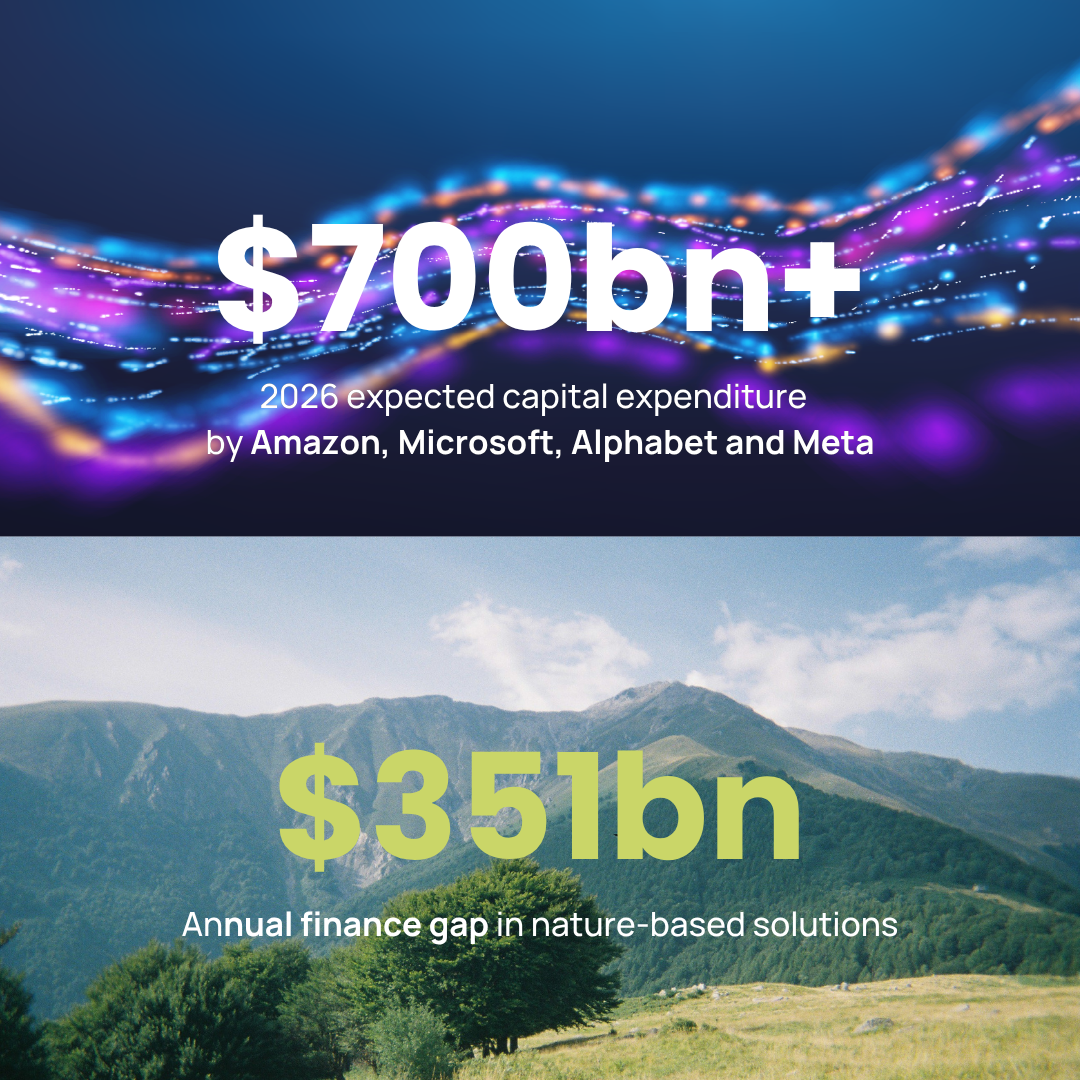
Private investors put just USD 23 billion into nature-based solutions in 2023. For comparison, Amazon, Microsoft, Alphabet and Meta expect to spend more than USD 700 billion in capital expenditure in 2026, much of it linked to AI, cloud and data-centre infrastructure.
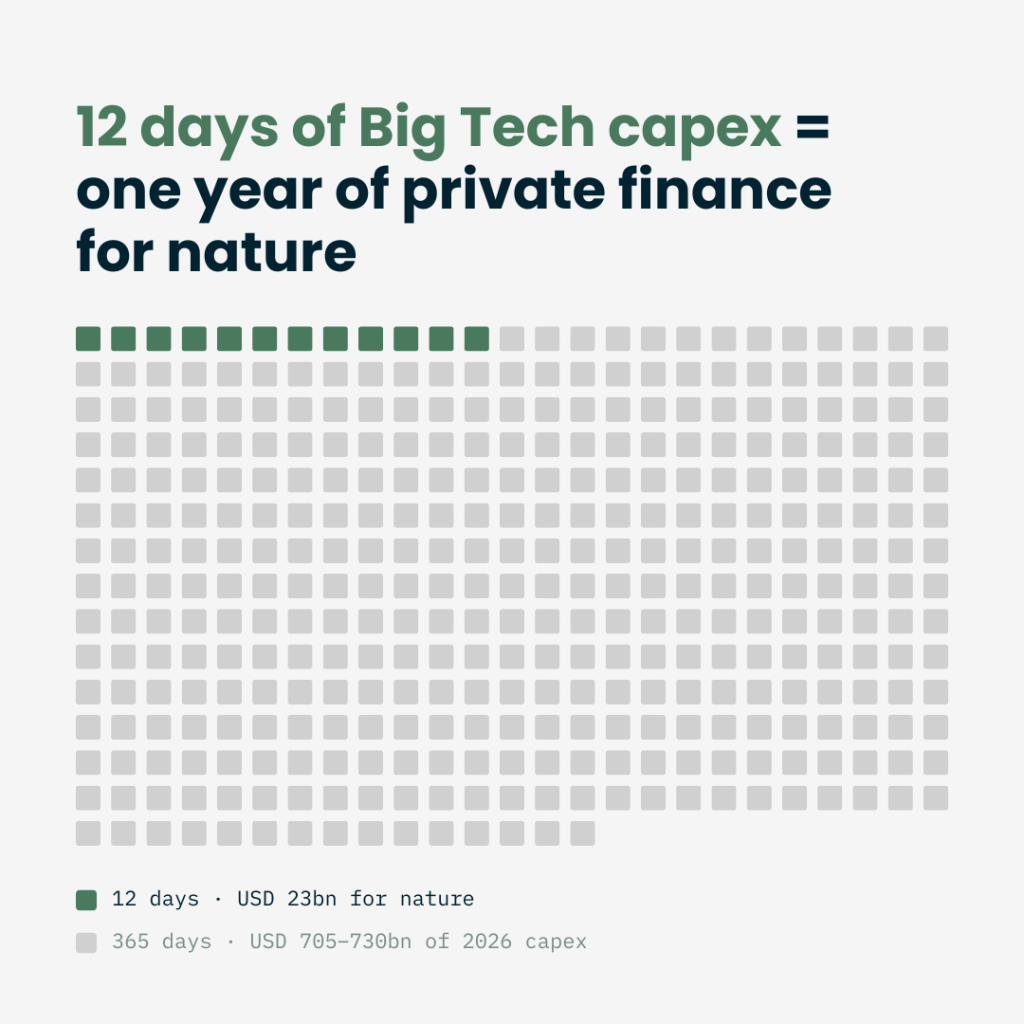
At that pace, those four companies spend the equivalent of a full year of private investment in nature-based solutions in roughly 12 days.
The comparison is imperfect. But it points to an important question: why is private capital able to move at such scale into infrastructure, while nature remains overwhelmingly dependent on public finance?
The answer is not simply a lack of interest in nature. It is that nature is still difficult to underwrite: difficult to measure consistently, difficult to turn into predictable revenues and difficult to price according to the risks avoided.
How much money goes into nature-based solutions?
UNEP’s State of Finance for Nature 2026 tracks global finance for nature-based solutions using 2023 data.
The figures are striking:
| Measure | 2023 value |
|---|---|
| Total finance for nature-based solutions | USD 220 billion |
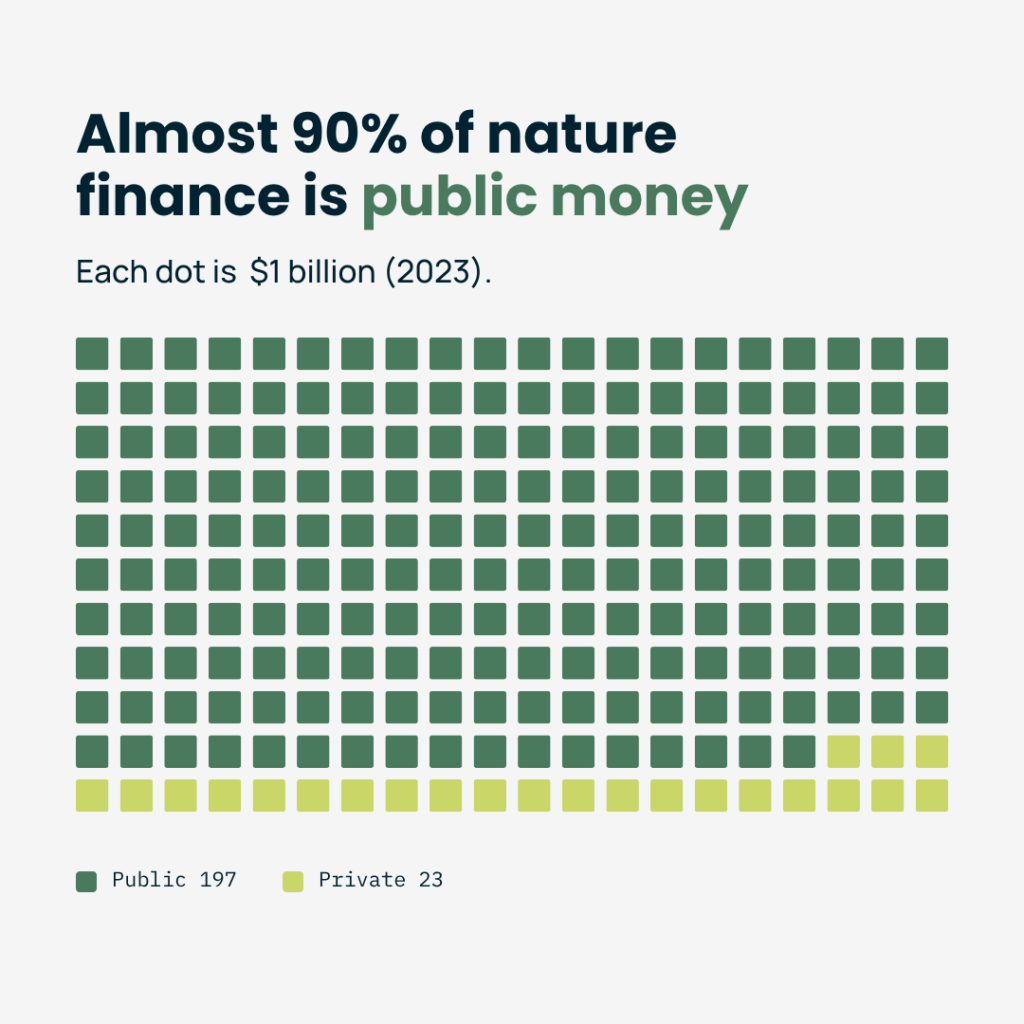
| Public finance | USD 197 billion |
| Private finance | USD 23 billion |
| Annual investment needed by 2030 | USD 571 billion |
| Annual finance gap | ~USD 351 billion |
| Finance flowing to nature-negative activities | USD 7.3 trillion |
Source: UNEP, State of Finance for Nature 2026, January 2026.
Nearly 90% of finance for nature-based solutions still comes from public sources.
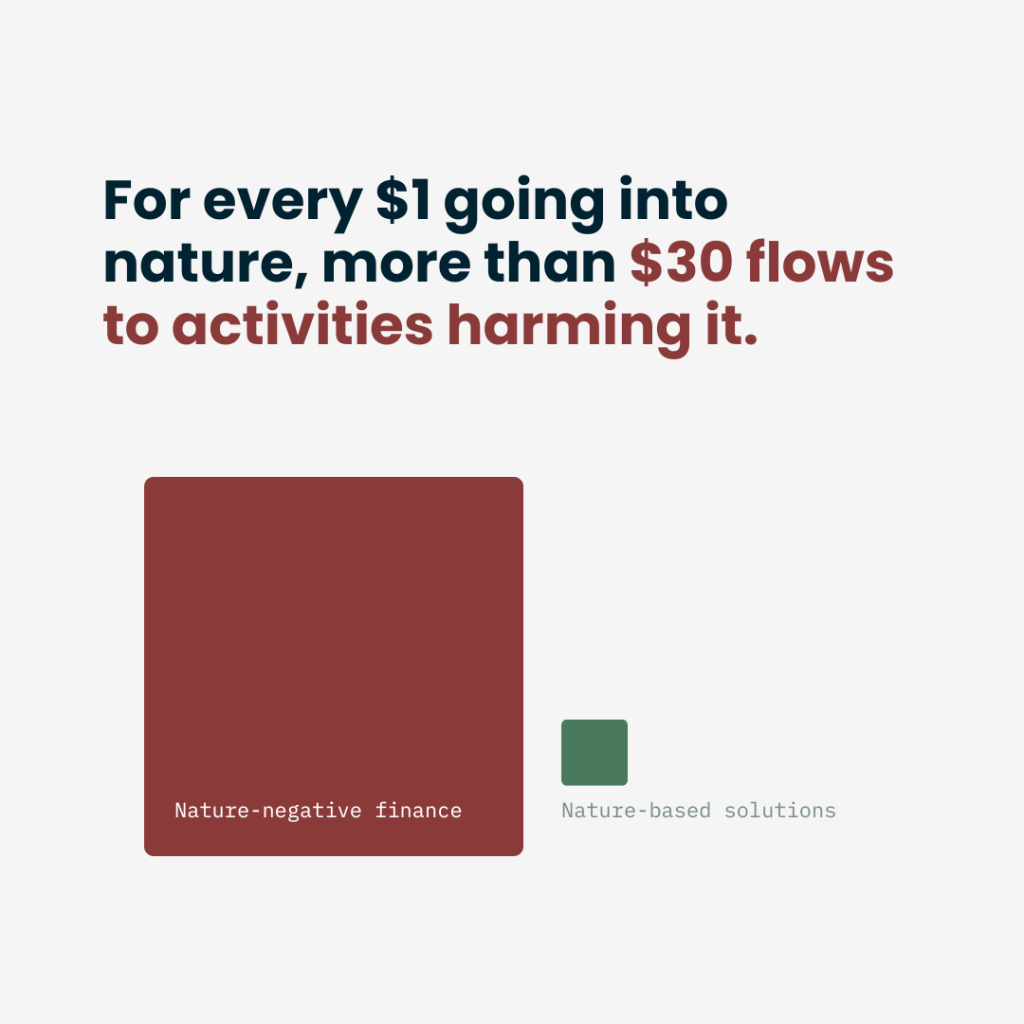
The imbalance is even larger when we look at where the rest of the economy is investing. For every USD 1 going towards nature-based solutions, roughly USD 30 flows into activities that harm nature.
Forests show a similar pattern. They received around USD 84 billion in 2023, while annual investment needs to reach approximately USD 300 billion by 2030. Private finance accounted for only around USD 7.5 billion.
Source: UNEP, State of Finance for Forests 2025.
Put that next to infrastructure investment
The scale of current technology investment helps put these figures into perspective.
Based on the latest 2026 company guidance, Amazon, Microsoft, Alphabet and Meta together expect capital expenditure of roughly USD 705–730 billion this year.
That means: One year of private finance for nature-based solutions, USD 23 billion, is equivalent to roughly 12 days of capital expenditure by those four companies.
Amazon alone now expects around USD 220 billion in capital expenditure in 2026, approximately the same amount as the entire world invested in nature-based solutions in 2023.
This does not mean the money could simply be moved from AI to forests. The two types of investment work very differently. A company investing in a data centre owns an asset. It can estimate its cost, capacity, revenue and useful life. Its performance can be monitored continuously.
Nature restoration produces value too, but much of that value is distributed across society rather than captured by the investor. That distinction matters.
So why is nature harder to finance?
There are three interconnected problems.
1. Can you prove what happened?
Investors need evidence. For a conventional asset, they can usually establish what was purchased, how it performs, how its value changes and how its financial performance is verified.
Restoration projects are harder to compare. A project may report trees planted, hectares restored or survival rates, but those figures can use different methodologies and baselines. Monitoring can also be irregular or difficult for an external party to verify.
This is changing. Satellite imagery, field data, sensors and digital monitoring systems can increasingly provide consistent evidence over time. But better measurement solves only part of the problem.
2. Can the investor capture the value created?
This may be the bigger challenge. The economic benefits of restoration can be substantial. UNEP estimates that every USD 1 invested in ecosystem restoration can generate up to USD 30 in economic benefits. Across restoration interventions, benefits are estimated to exceed costs by around nine times on average.
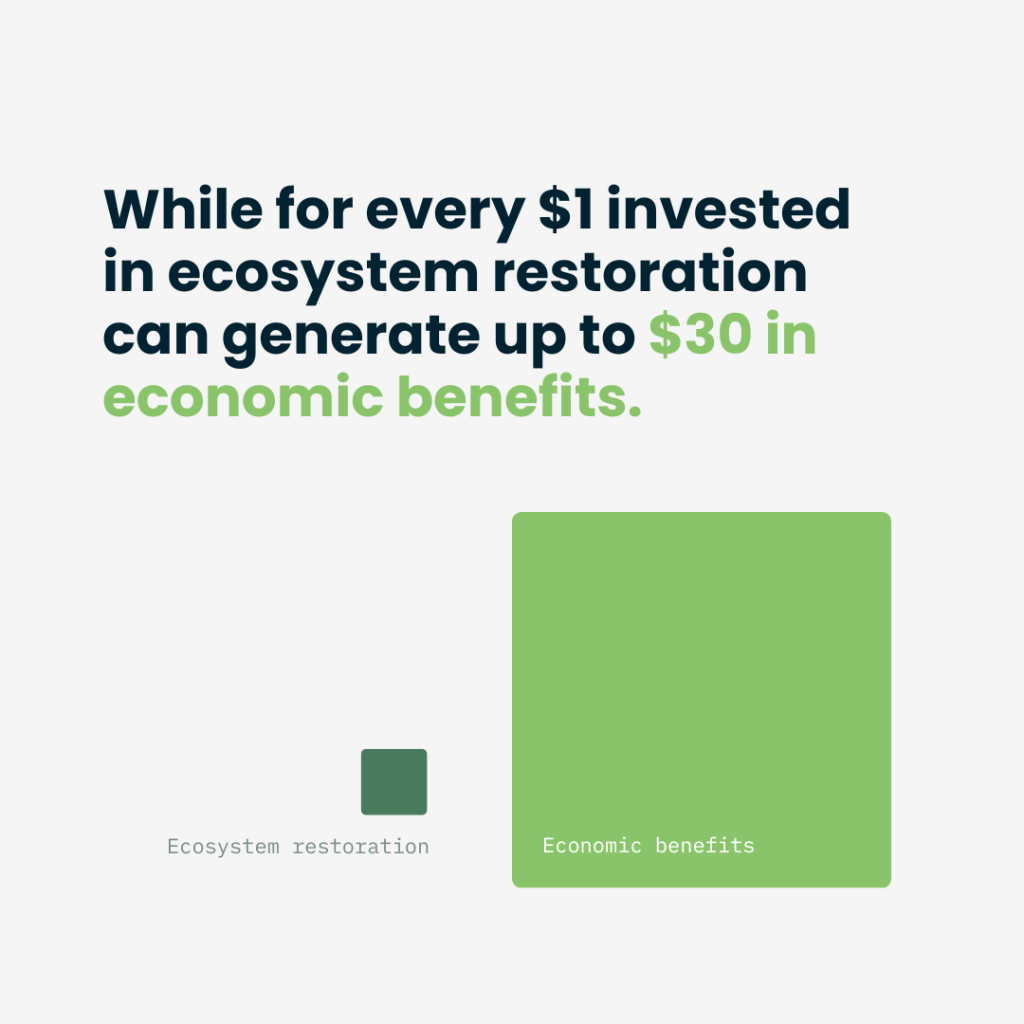
Source: UNEP, UN Decade on Ecosystem Restoration.
But who receives those benefits?
Restoring a watershed can reduce water-treatment costs, lower flood risk, improve agricultural productivity, support biodiversity and store carbon. The organisation paying for the restoration rarely receives all of those benefits financially.
This creates a fundamental problem for private investment: nature can create significant economic value without creating an equally clear revenue stream for the investor.
Carbon markets provide one mechanism for turning ecosystem benefits into revenue, but they remain relatively small. MSCI estimates that the primary global carbon-credit market was worth just over USD 1.4 billion in 2025.
Better monitoring can make nature more investable. But monitoring alone cannot create a business model.
3. Who pays for the cost of doing nothing?
There is also a problem on the other side of the equation.
The economic cost of nature loss is enormous, but much of it is not reflected in today’s financial decisions.
The World Bank estimates that the collapse of selected ecosystem services could reduce global GDP by USD 2.7 trillion per year by 2030. It projected that 51 countries could experience GDP declines of between 10% and 20% if vital ecosystem services collapse.
Source: World Bank, The Economic Case for Nature.
A 2026 study published in Nature Ecology & Evolution makes a similar point for sovereign debt. The researchers argue that biodiversity and ecosystem risks are largely absent from sovereign credit ratings, meaning financial markets may be mispricing environmental risk across an asset class worth roughly USD 83 trillion.
Source: Nature Ecology & Evolution, 2026.
In other words, investors do not capture much of the upside from restoring nature, while they also do not fully pay for the downside of losing it.
That is the financing gap we need to solve.
Measurement matters, but it is not enough
For restoration projects, credible monitoring is still fundamental. Private investment cannot scale without evidence that investors, insurers, governments and other third parties can trust. But better data alone will not suddenly turn restoration into an asset class.
UNEP’s recommendations reflect this. Alongside stronger disclosure, credible metrics and better project pipelines, it calls for guarantees, blended finance and other mechanisms that reduce risk for private investors.
The challenge is therefore bigger than reporting impact. It is about building the financial structures that allow part of nature’s value to reach the people financing it.
What would make restoration easier to invest in?
Four things can already make a significant difference:
- A clear baseline.
A fixed, timestamped picture of conditions before an intervention makes future claims much easier to verify. Historical satellite imagery means this can often be reconstructed even when monitoring started later. - Outcomes connected to a methodology.
“72% tree survival after 12 months, measured using a stratified sample of 400 trees” says much more than simply reporting “72% survival.” - Evidence over time.
Monitoring should not exist only when an annual report is produced. Satellite observations, field measurements, sensors and project updates can create a continuous record of what is changing. - Independent verification.
Third-party assessments and independently sourced environmental data make it possible for someone outside the project to check the claims being made.
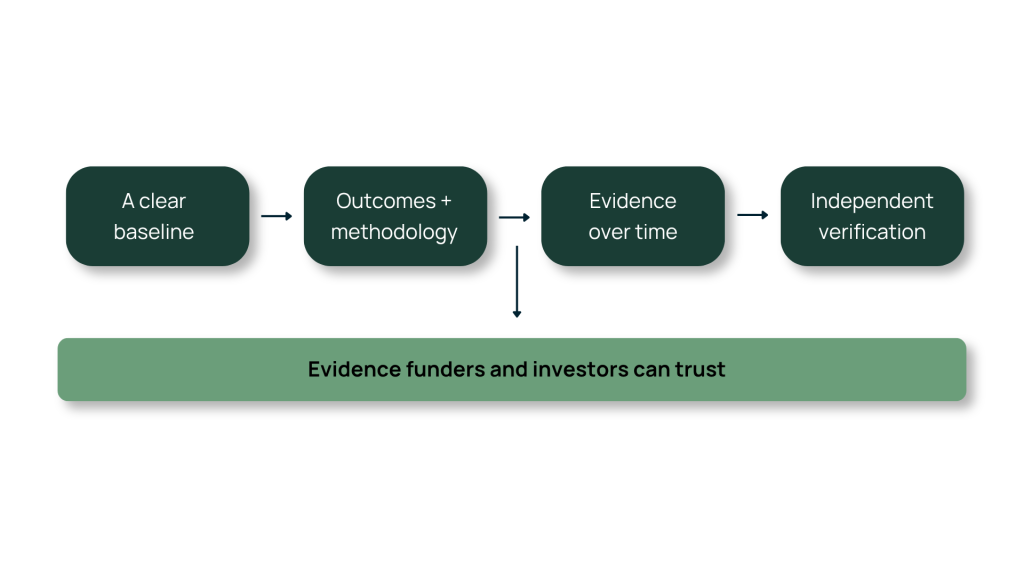
None of these technologies is particularly exotic. Much of the infrastructure already exists. The bigger shift is making this level of evidence normal for restoration projects rather than exceptional.
From reporting impact to financing it
Projects should increasingly ask a different question when designing their monitoring systems: Could someone outside our organisation verify what we are claiming?
For funders and companies, financing good monitoring should not simply be treated as administrative overhead. It helps build the evidence required to make larger and more sophisticated financing possible. And for the wider financial system, the biggest number remains USD 7.3 trillion. That is how much finance UNEP estimates flowed towards nature-negative activities in 2023.
There is no global shortage of capital. The challenge is creating the evidence, incentives and financial structures that allow more of it to flow towards nature.
Frequently asked questions
How much private finance goes into nature-based solutions?
Private sources provided around USD 23 billion in 2023, out of USD 220 billion in total finance for nature-based solutions. Nearly 90% therefore came from public sources.
What is the nature finance gap?
UNEP estimates that annual investment in nature-based solutions needs to reach USD 571 billion by 2030, compared with USD 220 billion in 2023. That leaves an annual gap of roughly USD 351 billion.
How does that compare with technology infrastructure investment?
Amazon, Microsoft, Alphabet and Meta currently expect combined 2026 capital expenditure of roughly USD 705–730 billion. That is more than three times the total annual finance currently going into nature-based solutions.
Does nature generate a financial return?
Nature restoration can generate substantial economic benefits. UNEP estimates benefits of up to USD 30 for every USD 1 invested. The problem is that much of this value goes to society, governments, businesses and communities rather than directly to whoever financed the restoration.
What does failing to invest in nature cost?
The World Bank estimates that the collapse of selected ecosystem services could reduce global GDP by USD 2.7 trillion annually by 2030.
OpenForests combines consulting and digital tools to make restoration visible, measurable and trustworthy. Through explorer.land, projects can connect baselines, monitoring data and evidence of change in one place, making their impact easier for funders, partners and other third parties to understand and verify.
Figures checked September 2026. Corporate capital-expenditure guidance can change during the year; UNEP and other global finance datasets are published with a reporting lag.