Monitoring Restoration Impact with WeForest

CLIENT
WeForest
PROJECT
Desa’a Forest restoration impact monitoring
LOCATION
Desa’a Forest, Ethiopia
SOLUTIONS
Impact Monitoring • Theory of Change • Indicator management • Consultancy
THE CLIENT
WeForest
WeForest is a non-profit organisation that has been conserving and restoring forest landscapes since 2009, making it one of the more established organisations in the Forest and Landscape Restoration sector.
From early on, transparency and accountability have been central to its approach. Over the years, WeForest has built collaborations with more than 450 partners, helping funders see how their contributions connect to restoration work on the ground. A key part of this approach has been to map restoration projects and funding contributions to specific project locations, hectares and numbers of trees, making the work visible and easier for partners to understand and follow.
This same philosophy applies to how WeForest measures restoration success. Its approach to Forest and Landscape Restoration goes far beyond counting trees planted. WeForest monitors ecological and social change to understand whether restoration activities are contributing to healthier forests, stronger livelihoods and more resilient landscapes.
In Ethiopia, WeForest works in the Desa’a Forest landscape, one of the country’s oldest remaining dry Afromontane forests. The landscape has been severely affected by land degradation, grazing, wood collection, soil erosion and increasingly difficult climatic conditions.
The restoration programme combines assisted natural regeneration, enrichment planting, soil and water conservation, community engagement and livelihood activities.
Understanding whether these activities are leading to longer-term ecological and social change is therefore essential, not only for WeForest’s teams, but also for the partners funding the restoration.
THE CHALLENGE
Representing the complexity of WeForest’s restoration work
WeForest already had an established, science-based monitoring approach and used a logical framework to organise project objectives and indicators.
A framework provides a useful structure for defining expected results and assigning indicators to them. However, it often presents the relationship between interventions and results as a relatively linear sequence.
But restoration rarely works in such a simple, linear way.
One activity may contribute to several outputs and outcomes. An outcome may depend on a combination of ecological and social interventions. The same indicator may provide evidence for more than one objective, while external factors such as rainfall, grazing pressure, community participation or implementation conditions can influence the results.
For example, assisted natural regeneration may contribute to vegetation recovery, soil protection, biodiversity and water retention. At the same time, its success may depend on local agreements, grazing management and continued community participation.
The challenge was therefore not to replace WeForest’s monitoring methodology. It was to make the connections within it easier to see and understand.
WeForest needed a structure that could:
- retain the project information and indicators already in use;
- show the relationships between activities, outputs, outcomes and impact;
- show multiple connections instead of forcing each element into a single pathway;
- connect project-level results with WeForest’s wider strategic goals;
- make the full logic of the restoration programme easier to explore;
- support learning, management and communication.
OUR APPROACH
Translating WeForest’s monitoring framework into an interactive Theory of Change
WeForest provided the existing project information, including its activities, expected results, indicators and impact dimensions.
Together with the WeForest team, OpenForests reviewed and reorganised this information within explorer.land’s Interactive Theory of Change.
01
Structuring the existing monitoring information
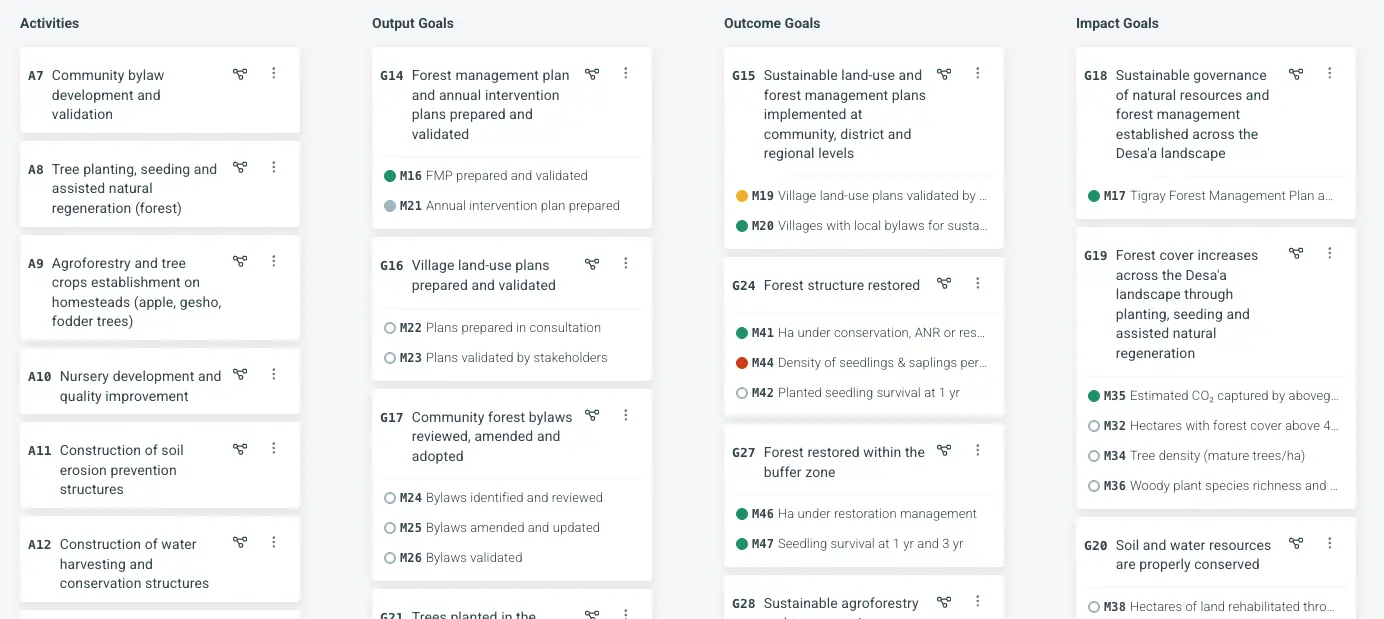
The first step was to organise the information provided by WeForest into distinct levels of the results chain: activities, outputs, outcomes and strategic impact dimensions.
This matters because each level represents a different stage of change. Keeping them separate makes it easier to understand how one step is expected to lead to the next.
Activities describe what the project implements. Outputs describe the immediate results of that work. Outcomes describe the changes expected to emerge. Impact refers to the broader ecological and social objectives to which the project contributes.
Keeping these levels separate helps avoid presenting completed activities as evidence of long-term impact before that change has been observed.
02
Mapping multiple connections across the results chain
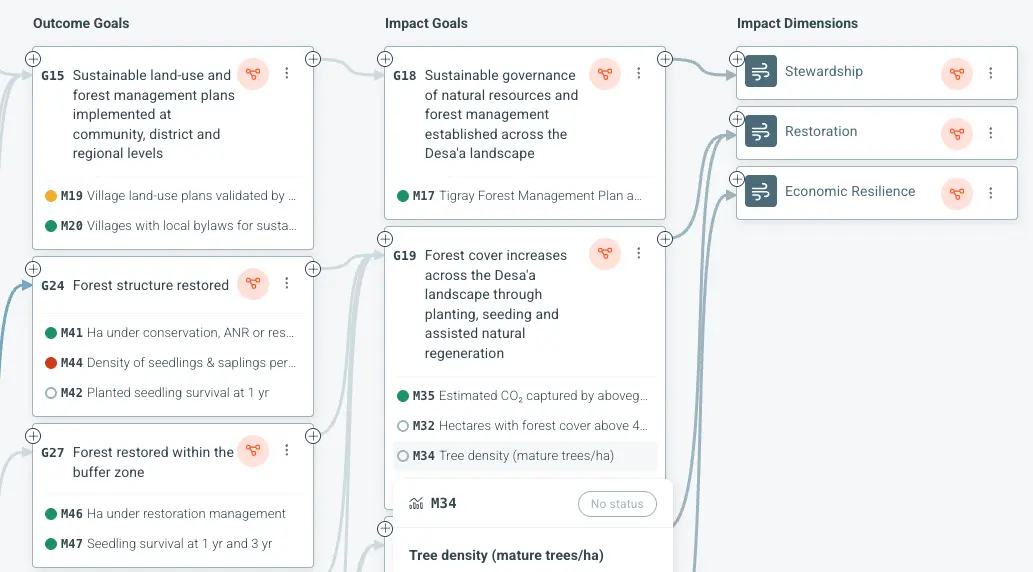
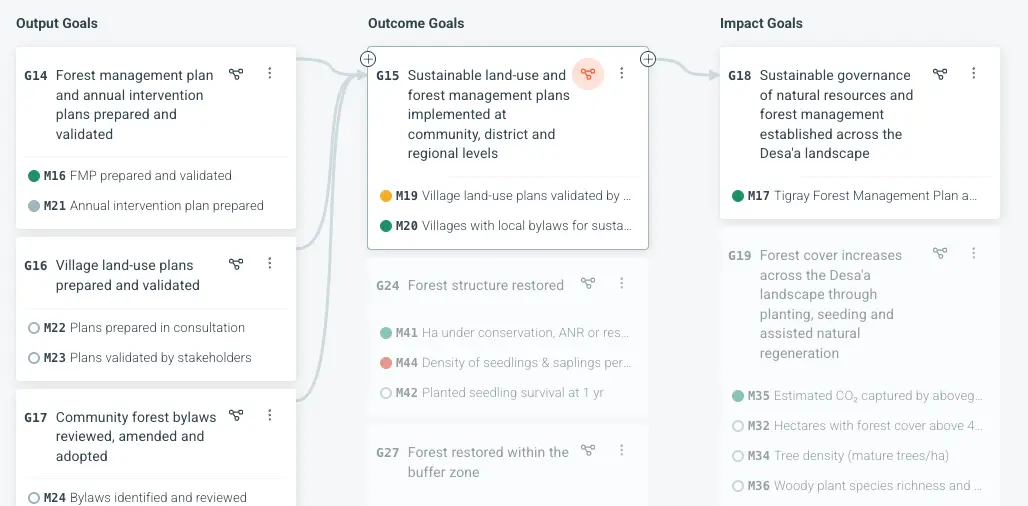
The Theory of Change expands the more linear structure of a traditional logframe by showing the multiple relationships between project elements.
An activity can be connected to several outputs. An output can contribute to different ecological and social outcomes. Several activities may also need to work together before a particular outcome becomes visible.
This gives WeForest a clearer picture of how change is expected to happen across the project.
Instead of showing only that one indicator relates to one result, the dashboard can represent how:
- several activities contribute to the same outcome;
- one intervention supports different strategic objectives;
- ecological and social results influence one another;
the same indicator can provide evidence in different parts of the Theory of Change; - short-term results connect with longer-term change.
This reflects the reality that forest restoration is a system of interacting interventions rather than a series of isolated actions.
03
Connecting indicators to the Theory of Change
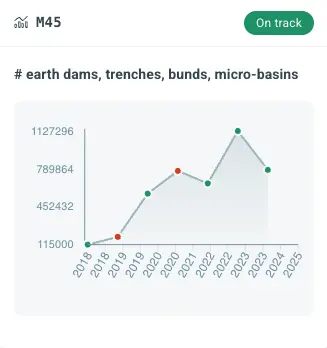
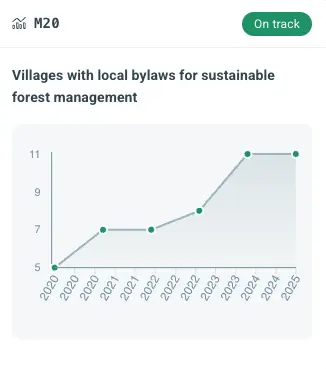
Indicators are assigned to the relevant goals of the results chain: Output indicators record their direct and immediate results. Outcome indicators provide evidence of emerging change. Impact indicators relate to long-term ecological and social objectives.
This structure helps WeForest see where progress is happening and where a closer look may be needed.
For example, when an activity has been implemented but its expected output is weaker than anticipated, project teams can investigate implementation conditions.
When the planned outputs have been delivered but the expected outcome is not yet visible,teams can ask a series of practical questions: Does the change simply need more time? Is the indicator measuring the right thing? Are external factors affecting the result? Does the assumed relationship need to be reconsidered? Or is more evidence needed?
explorer.land’s Impact Monitoring module therefore complements WeForest’s monitoring methods by making the relationships between indicators and expected change easier to follow.
04
Aligning the project with WeForest’s strategic goals
WeForest’s impact dimensions were integrated into the monitoring system as the broader framework around the project.
Activities, outputs and outcomes can therefore be connected to the wider organisational goals they are intended to support.
This creates a clearer relationship between work carried out in Desa’a and WeForest’s broader environmental and social priorities.
For example, an intervention may contribute simultaneously to forest health, biodiversity, soil and water conservation, community resilience or sustainable livelihoods.
Rather than assigning the intervention to only one category, the Theory of Change can retain these multiple relationships.
THE RESULTS
A clearer view of how restoration activities contribute to impact
The Impact Monitoring tool provides WeForest with a structured representation of the Desa’a project’s Theory of Change.
It builds on WeForest’s existing monitoring work while making the relationships between interventions, indicators and long-term objectives more visible.
The resulting structure helps WeForest to:
- retain and organise its existing monitoring information
- distinguish activities, outputs, outcomes and impact;
- represent multiple connections across the results chain;
- connect indicators with the results they are intended to assess;
- relate project interventions to strategic impact dimensions;
- identify assumptions and potential monitoring gaps;
- understand and communicate how project activities are expected to lead to long-term change.
A more outward-facing version is also planned for investors and funding partners. Its aim will be to surface the most relevant impact information in a simpler view, so partners can quickly understand what the programme is doing, what is changing and how this connects to the impact they are supporting.
The tool does not replace the science behind impact assessment. Determining whether the project has achieved impact continues to depend on suitable monitoring methodologies, reliable data, scientific interpretation and local knowledge. Its role is to bring that information together in a structure that makes the path from restoration activities to long-term impact easier to see.
OpenForest’s impact monitoring tools help WeForest derive even more value out of years of rigorous monitoring data, connecting sources into a unified picture of our Theory of Change. Our strategic partnership with OpenForest underscores our long-standing commitment to transparency, giving our funding partners a clearer, more credible line of sight from their contribution to the long-term project impact.

BEYOND THE CANOPY
Forests: Reasons to be hopeful with Marie-Noëlle Keijzer
FOR OTHERS
What the WeForest case demonstrates
The WeForest case shows how an existing monitoring framework can be expanded into a more connected Theory of Change.
Traditional logframes remain useful for defining objectives, results and indicators. A more interconnected model can complement them by representing the multiple pathways through which restoration activities may contribute to ecological and social change.
For complex Nature-based Solutions, this provides a more realistic way to organise impact monitoring while building on the methods, indicators and knowledge an organisation already has.