Key takeaways on The Global Biodiversity Standard (TGBS)
- TGBS verifies biodiversity recovery on the ground. It focuses on measurable ecological outcomes, including ecosystem integrity, species composition, ecological structure and function
- It adds independent, site based verification. Trained local experts assess projects in the field, providing evidence that remote sensing and project reporting alone cannot provide.
- It is designed for restoration projects globally. The methodology is globally applicable, while assessments are carried out by experts familiar with the local ecosystem, species and social context
- Certification is tiered and supports continuous improvement. Projects can use the assessment to identify ecological risks, improve restoration practices and demonstrate progress over time
- It can strengthen trust in biodiversity claims. Independent certification gives funders, investors, regulators and other stakeholders a stronger basis for evaluating restoration outcomes
- TGBS and geo transparency tools such as explorer.land play complementary roles. Digital monitoring can show where and how landscapes are changing, while TGBS provides field based verification of the ecological quality of that change.
What does it actually mean to say that a restoration project is recovering biodiversity?
The Global Biodiversity Standard (TGBS) was created to help answer that question with evidence from the ground. Rather than focusing only on project processes or safeguards, TGBS assesses measurable biodiversity outcomes through a globally consistent methodology combined with field assessments by local ecological experts.
Developed with organisations including Botanic Gardens Conservation International (BGCI), the Society for Ecological Restoration (SER), Plan Vivo and Ecosia, TGBS is designed to provide independent evidence that restoration is leading to meaningful ecological recovery.
We spoke with Antonia Burchard-Levine, Network & Impact Officer for Tree Planting Projects at Ecosia, about why TGBS was created, how certification works, what it requires from restoration organisations, and how field based biodiversity assessment can complement satellite monitoring and geo transparency platforms such as explorer.land.
Why another standard? How does The Global Biodiversity Standard (TGBS) differ from existing frameworks like CCBA or Preferred by Nature?
As biodiversity loss is now recognised as a material ecological and financial risk (on many levels), companies, governments, investors, and conservation bodies need a scientifically robust, site-based, globally comparable way to verify that ecosystems are actually recovering. Yet many existing standards focus on safeguards, management processes, or risk mitigation, rather than directly measuring whether biodiversity is actually recovering.
TGBS fills that gap.
The Global Biodiversity Standard (TGBS) stands out because it is a site-based, outcome-focused certification that verifies real, measurable biodiversity recovery. It measures improvements in ecosystem integrity, species composition, ecological structure, and functional interactions (e.g. pollination, regeneration, trophic relationships), and also the impact that restoration activities have on local communities and the benefits they provide to them.
In short, TGBS exists to address the missing piece: a credible and site-based verified proof of nature recovery on the ground, not just on paper.
Developed by science-driven organisations like Botanic Gardens Conservation International and the Society for Ecological Restoration, peer-reviewed by leading biodiversity scientists, and tested across more than 100 sites in multiple countries, TGBS blends strong ecological rigour with practical usability. It is aligned with international restoration principles, global biodiversity policy frameworks, and recognised standards of ecological practice — ensuring consistency with the Kunming-Montreal Global Biodiversity Framework and emerging restoration regulation. Its multi-tier certification system also ensures continuous improvement and makes it one of the most credible, transparent, and biodiversity-first assessment frameworks available.
Finally, TGBS operates through a decentralised hub model, meaning local experts who understand the ecological, cultural, and social context of each landscape are directly responsible for guiding the assessment and verification process. This avoids fly-in, fly-out consultancy approaches and ensures that biodiversity outcomes are grounded in site-specific ecological and taxonomic – particularly critical in hyperdiverse tropical regions, where accurate species identification is complex and misidentification can lead to the introduction of non-native or even invasive species. By mobilising local botanists and restoration ecologists, TGBS reduces ecological risk, ensures the right species are selected for the right place, and removes technical burden from project developers by providing independent, science-based verification supported by local expertise.
Why should an organization take the extra effort to comply with TGBS besides the inherent goal of restoring nature?
The Global Biodiversity Standard (TGBS) follows a rigorous methodology developed by scientific institutions like Botanic Gardens Conservation International (BGCI) and the Society for Ecological Restoration (SER), standards-bodies like Plan Vivo and reputable implementing organisations like Ecosia. Certification provides credible, independent, third-party assurance that a project delivers real biodiversity outcomes – something investors, funders, regulators, and customers increasingly require to make confident and defensible decisions.
The standard is outcome-focused and tiered, offering clear signals about what good restoration practice looks like in different ecological conditions. By making biodiversity risks, trade-offs and unintended impacts visible early, TGBS offers a clear roadmap for continuous improvement, helps organisations avoid late-stage redesign and reputational exposure. Moreover, by providing operational guidance TGBS helps improve project quality, long-term resilience, and stakeholder confidence.
Beyond the inherent goal of restoring nature, complying with TGBS strengthens organisational credibility, competitiveness and reputation, reduces operational and regulatory risks and supports alignment with emerging policy and reporting frameworks. Certification can also enhance access to sustainable finance, reputation and stakeholder trust.
What role does geography play in selecting restoration partners, and why are the Bolivia and Uganda projects considered high-integrity benchmarks for biodiversity?
The TGBS methodology is designed to be globally applicable across most ecosystems, however geography shapes who carries out the assessment of the project. As mentioned above, projects are assessed by experts with deep knowledge of the specific biome, native species, local conservation priorities, and social factors such as community engagement. For this reason, TGBS mobilises local experts to carry out assessments using the TGBS methodology.
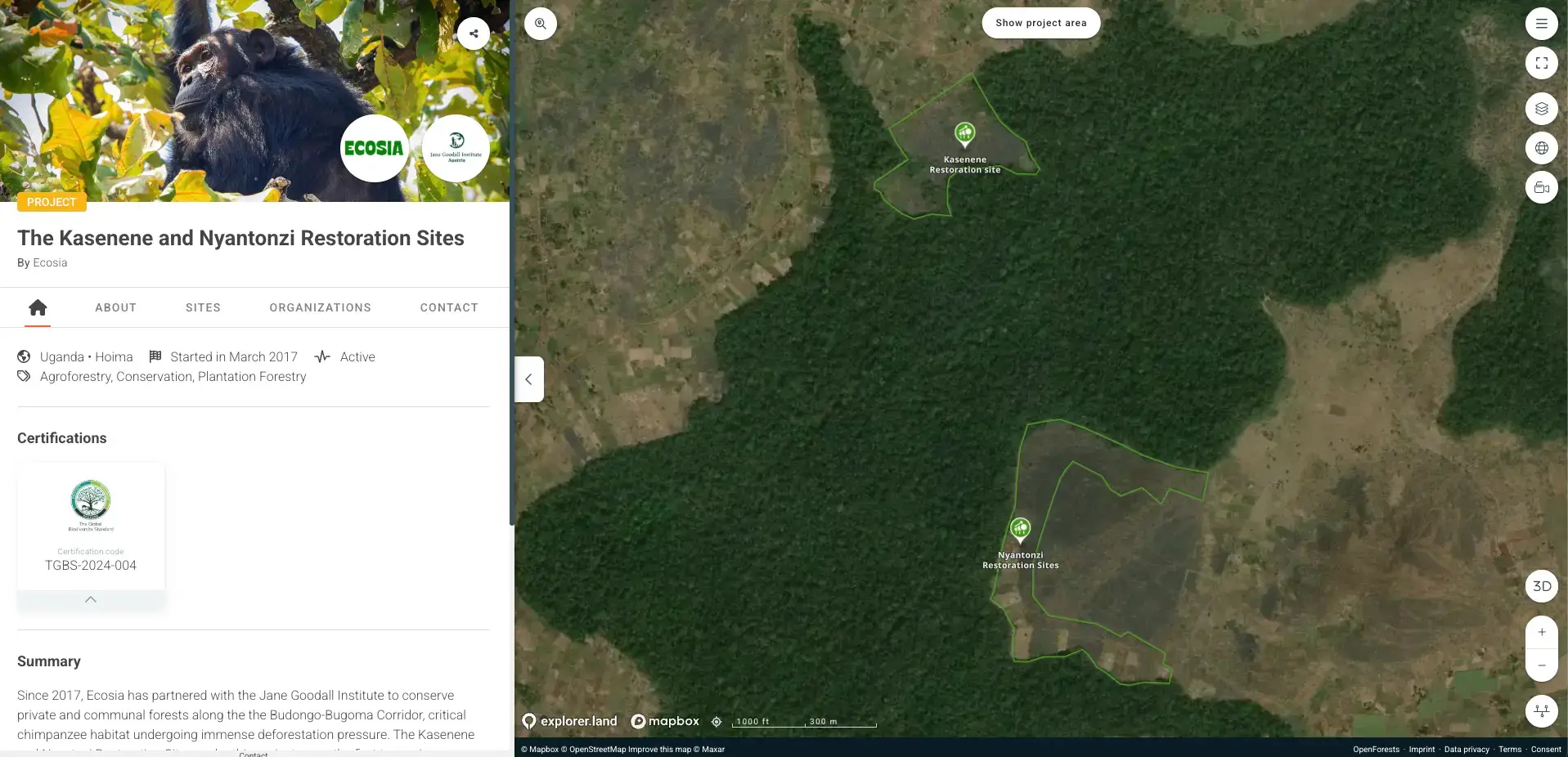
For example, the assessment of the SICIREC project Bolivia was carried out by Huarango Nature, while the one in Uganda with the Jane Goodall Institute by Tooro Botanical Gardens.
The projects in Bolivia and Uganda (financially supported by Ecosia) were the first to receive TGBS certification. The Jane Goodall Institute (JGI) project in Uganda, was the first to receive the Advanced certification tier.
Since then seven projects have received TGBS certification, including the first Premium-Tier TGBS-certified site in the world, and the first in East Asia. This site is the forest restoration landscape managed by Kadoorie Farm & Botanic Garden (KFBG) in Hong Kong.
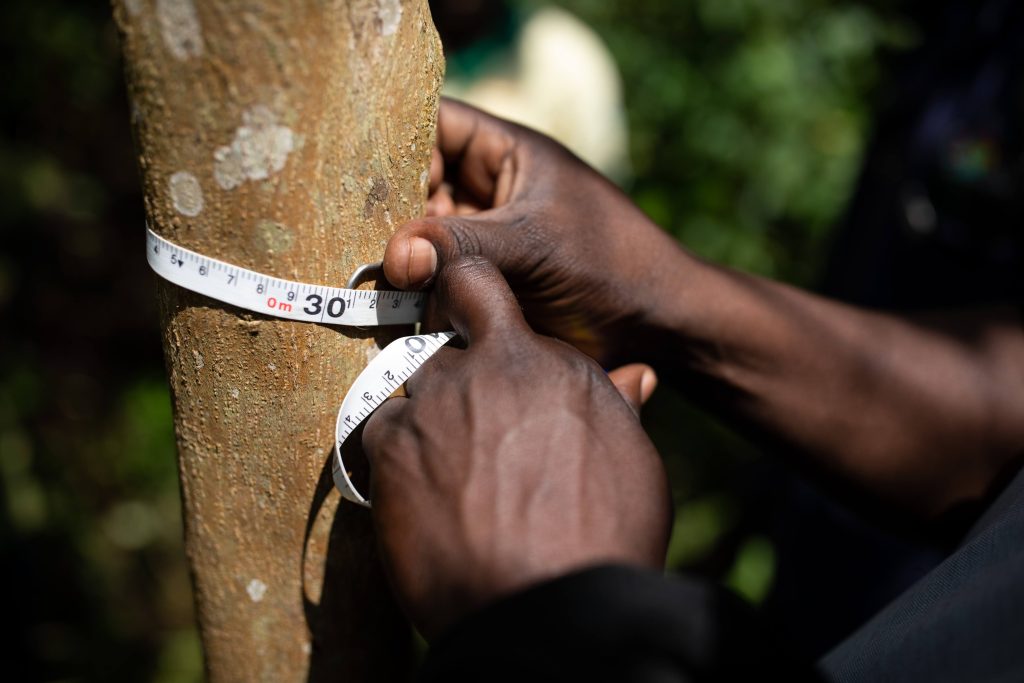
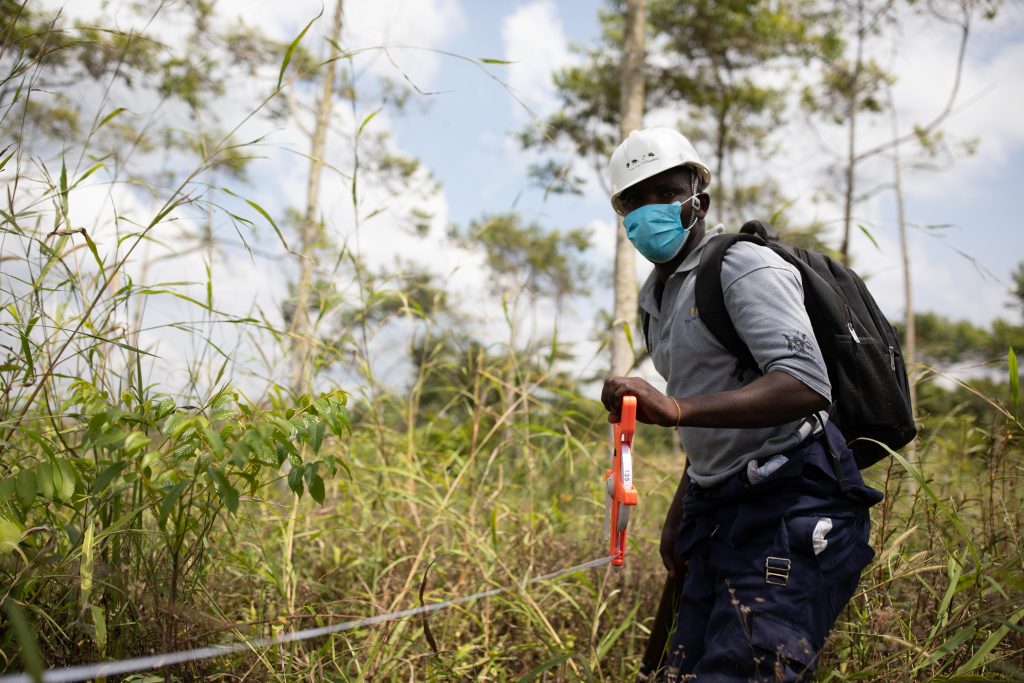
Photos credit: Luke Dray
How does TGBS complement the geo-transparency of platforms like explorer.land?
TGBS complements the geo-transparency of platforms like explorer.land by adding a rigorous, independent layer of scientific credibility and quality assurance to what satellite imagery can reveal. While explorer.land shows where activities occur, satellite timelines and integrated datasets, biodiversity outcomes cannot be reliably assessed through remote sensing alone. Ecological appropriateness, species composition, restoration trajectories and social impacts require site-based assessment and expert field surveys.
TGBS therefore provides an additional science-based ground truthing of whether biodiversity outcomes are appropriate, credible and improving over time. TGBS therefore verifies that restoration activities are well designed, implemented, and monitored to deliver real biodiversity gains. It provides standardized methodologies, evidence requirements, and independent validation that ensure on-the-ground outcomes are scientifically robust, comparable, and trustworthy.
The two approaches are complementary: explorer.land enhances transparency about where change is happening, while TGBS strengthens confidence in the ecological quality and integrity of that change. In essence, explorer.land visualizes the action, and TGBS certifies that the action is meaningful, effective, and grounded in sound ecological practice.
What is the additional effort in terms of cost and time for a project developer to achieve TGBS certification, and what are the specific benefits of doing so?
Achieving TGBS requires robust ecological monitoring, documentation, and assessment costs. However, it provides powerful benefits and credible third-party proof of biodiversity recovery, all while reducing greenwashing risk, stronger stakeholder trust, and a globally recognised benchmark of ecosystem performance.
TGBS can ultimately prove cost-effective because its investment in monitoring, assessment, and certification directly improves ecological success, reduces long-term maintenance and restoration failures, and strengthens management decisions. Importantly, TGBS does not require project developers to build in-house taxonomic or advanced ecological monitoring teams in order to qualify for certification. Biodiversity assessment is conducted independently by trained, certified assessors operating through the TGBS hub network. This shifts the responsibility for ecological judgement and outcome evaluation away from developer self-reporting and toward independent, science-based assessment.
As a result, biodiversity performance is evaluated using a consistent methodology grounded in ecological expertise, rather than relying solely on internal calculations or project narratives. This reduces conflicts of interest, strengthens credibility, and provides a defensible basis for communicating biodiversity outcomes to investors, funders, regulators, and the public.
Practical commitment of organizations:
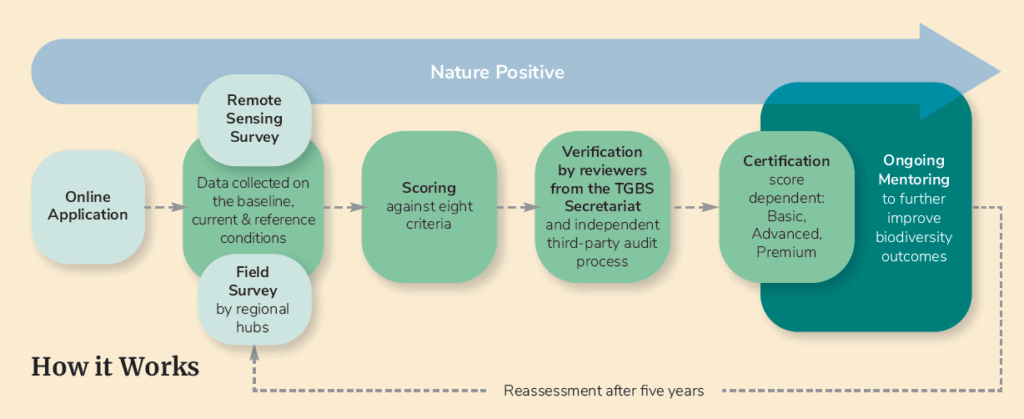
- Completing an application form and providing baseline project information where available
- Supplying relevant ecological, management and monitoring documentation
- Hosting and facilitating a field visit by trained, locally embedded assessors
- Providing access to sites, stakeholders and relevant data
- Engaging with assessment findings and, where relevant, addressing identified ecological risks or gaps
Learn more about The Global Biodiversity Standard: https://www.biodiversitystandard.org/