
Key highlights
- The EU Nature Restoration Law sets legally binding restoration targets for Member States, with measures covering at least 20% of EU land areas and 20% of sea areas by 2030.
- The deadline for draft National Restoration Plans was 1 September 2026. Only seven Member States were reported to have submitted their drafts by the deadline, highlighting the challenges of turning EU-wide ambitions into national action.
- The regulation marks an important shift from protecting nature to actively restoring degraded ecosystems, including forests, wetlands, rivers, agricultural landscapes and marine habitats.
- Putting restoration measures in place is not the same as achieving ecological recovery. Reliable baselines, appropriate indicators and long-term monitoring will be essential to evaluate outcomes.
- Funding, local participation and scientific evidence will determine whether the law delivers lasting results. The next challenge is translating European targets into effective restoration on the ground.
The first deadline: National Restoration Plans
On 1 September 2026, EU Member States reached an important deadline: submitting their draft National Restoration Plans to the European Commission.
These plans set out how each country intends to meet the targets established by the EU Nature Restoration Law, officially known as the Nature Restoration Regulation (EU) 2024/1991.
The deadline marked an important transition. After years of negotiations over what Europe should do to reverse ecosystem degradation, Member States were expected to explain how they would put those commitments into practice.
But the first milestone has also exposed implementation difficulties.
By 2 September 2026, seven Member States (Austria, Bulgaria, Ireland, Luxembourg, the Netherlands, Portugal and Spain) had submitted their draft plans, according to reporting based on official sources. During the European Parliament’s October debate, some MEPs cited a figure of just nine submissions, although this was not presented as a confirmed Commission tally.
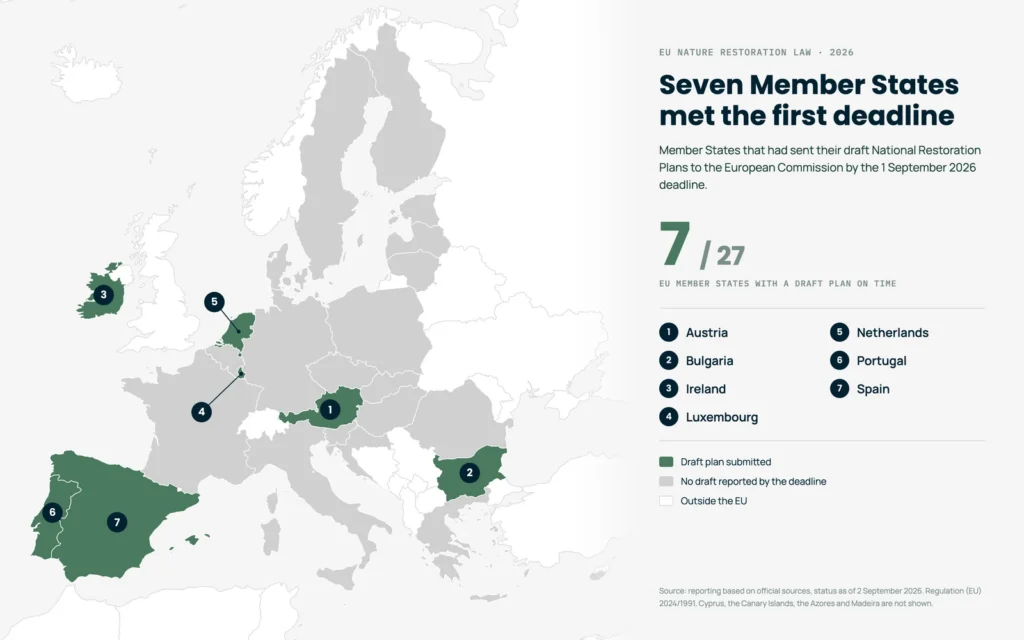
These figures reflect the status reported in September and October 2026; those initial delays reveal how demanding the planning process is proving to be.
Importantly, the Commission’s role is to assess the plans and provide observations, not to formally approve or reject them. The responsibility for delivering restoration measures remains with Member States.
The question is no longer whether Europe needs to restore nature. The scientific evidence is clear, and the regulation is already in force.
The question now is whether the EU can turn legally binding restoration targets into measurable, lasting ecological recovery.
For restoration organisations, land managers and funders, another question is emerging: how will national plans influence the projects, partnerships and environmental evidence needed to deliver those targets?
To understand what is at stake, it helps to look at what the law requires, what it gets right and where implementation may prove more difficult than setting the targets.
What is the EU Nature Restoration Law?
The EU Nature Restoration Law is the first EU-wide regulation establishing legally binding targets specifically for ecosystem restoration.
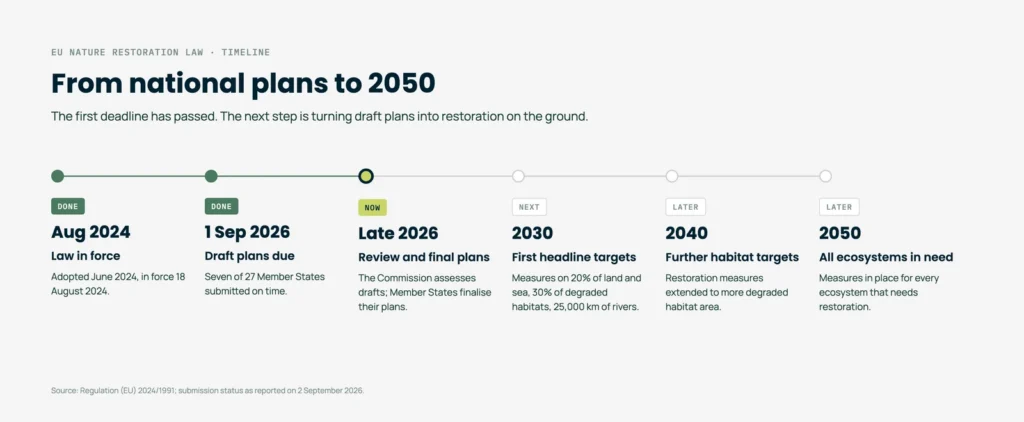
Adopted in June 2024 and in force since 18 August 2024, it aims to reverse biodiversity loss, improve ecosystem resilience and support climate mitigation and adaptation.
Its overarching target is to put effective, area-based restoration measures in place covering:
- At least 20% of EU land areas and 20% of sea areas by 2030.
- All ecosystems in need of restoration by 2050.
The regulation goes beyond protected nature reserves. It covers a wide range of ecosystems, including terrestrial, coastal, freshwater and marine habitats, agricultural ecosystems, forests, urban green spaces and rivers.
Specific obligations include restoring degraded habitats, reversing the decline of pollinators, improving indicators of agricultural and forest ecosystem biodiversity, and contributing to the restoration of at least 25,000 kilometres of rivers into free-flowing rivers by 2030.
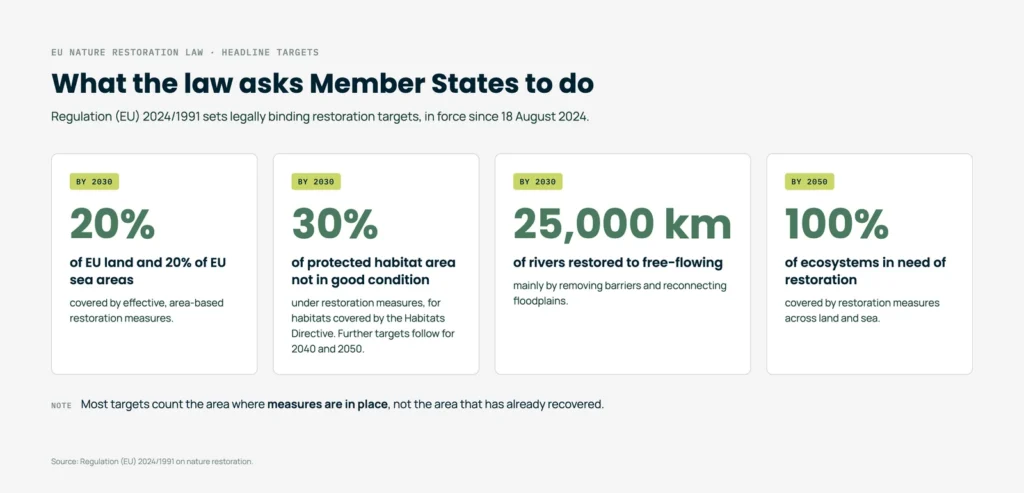
For certain habitats covered by the Habitats Directive, the regulation also establishes progressive restoration requirements. By 2030, Member States must put measures in place on at least 30% of the relevant habitat area that is not in good condition, with further targets for 2040 and 2050.
An important distinction is that these targets often refer to areas where restoration measures must be implemented, rather than areas that must already have reached good ecological condition by the target date.
That distinction matters because ecosystems do not recover according to legislative calendars.
A drained peatland may require years of rewetting before its ecological functions improve significantly. A restored forest may take decades to develop structural complexity. And removing a barrier from a river does not automatically guarantee the recovery of fish populations.
The law recognises that restoration is a process. The challenge is ensuring that implementation measures lead to the ecological improvements they are intended to achieve.
The full obligations, ecosystem-specific targets and reporting requirements are established in Regulation (EU) 2024/1991.
Why does Europe need a Nature Restoration Law?
Europe’s ecosystems are under considerable pressure.
According to the European Environment Agency’s State of Nature assessment, published in 2020 and covering 2013 to 2018, 81% of habitat assessments under the EU Habitats Directive indicate poor or bad conservation status. Only 15% of assessed habitats are in good condition.
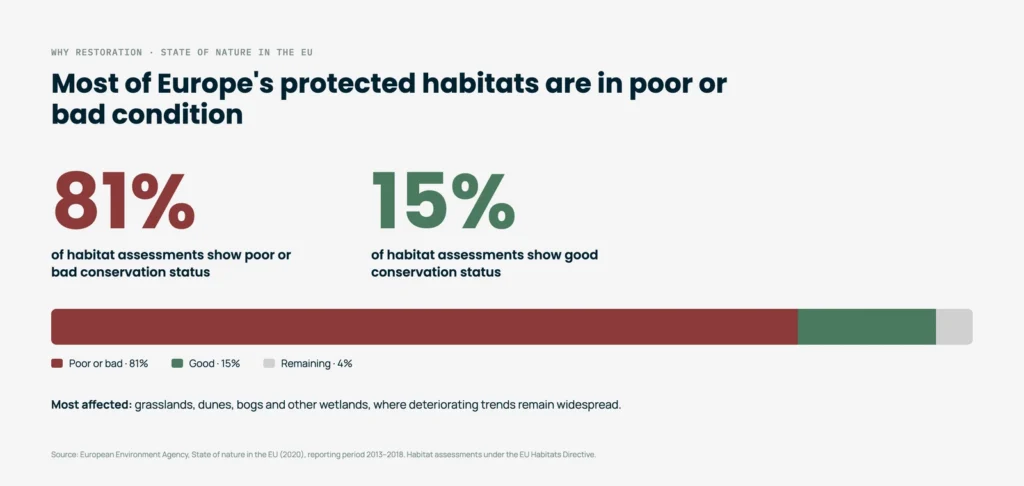
The situation is particularly concerning for grasslands, dunes, bogs and other wetland ecosystems, where deteriorating trends remain widespread.
These figures reflect the combined effects of land-use change, intensive resource use, pollution, infrastructure development, invasive alien species and climate change.
They also show the limitations of conservation policies focused primarily on preventing further damage.
Protecting remaining healthy ecosystems is essential, but protection alone cannot restore the ecological functions already lost from degraded landscapes.
A river can remain protected on paper while its natural flow is interrupted. A forest can retain tree cover while losing species diversity and structural complexity. A wetland can still appear on a map while its water regime has been fundamentally altered.
Restoration addresses a different question: how can ecological processes, biodiversity and ecosystem functions recover where they have been damaged?
This is particularly relevant as Europe faces increasing climate-related pressures.
Healthy wetlands can help retain water and reduce flood risks. Diverse forests can support resilience to environmental disturbances. Functioning soils contribute to water infiltration, nutrient cycling and agricultural productivity.
Restoring these functions is not simply a biodiversity objective. It is also a question of long-term environmental and economic resilience.
What does the Nature Restoration Law get right?
1. It turns restoration into a legal commitment
One of the regulation’s most important contributions is that it moves restoration beyond voluntary commitments.
For years, governments, businesses and organisations have announced ambitious environmental goals. But ambition alone does not guarantee implementation.
The Nature Restoration Law introduces binding obligations, national planning requirements, monitoring and reporting mechanisms.
Member States must identify where restoration is needed, determine appropriate measures and establish how progress will be monitored.
This creates a more structured basis for accountability than broad environmental commitments without defined implementation requirements.
However, a legal obligation is only as effective as the capacity to implement and enforce it.
2. It recognises that restoration goes beyond forests
Public discussions about ecosystem restoration often focus on tree planting.
Yet planting trees is neither necessary nor appropriate in every ecosystem.
Natural grasslands, peatlands, wetlands and open habitats can be damaged by poorly planned afforestation. Similarly, increasing tree cover does not necessarily improve biodiversity or restore ecosystem functions.
The Nature Restoration Law takes a broader ecological approach.
It includes different ecosystem types and establishes obligations that reflect their distinct characteristics.
For rivers, restoration may involve removing barriers and reconnecting floodplains. For peatlands, it may involve restoring water levels. For agricultural landscapes, it can mean improving conditions for pollinators and other biodiversity.
This matters because effective restoration starts with understanding the ecosystem, not selecting an intervention in advance.
3. It connects restoration with monitoring and long-term planning
The regulation does not stop at defining restoration targets.
It also requires Member States to monitor relevant indicators and report on progress, while national plans must identify restoration needs, measures, financing and monitoring arrangements.
The framework includes mechanisms for assessing improvement in habitat conditions and reviewing national restoration plans as new information becomes available.
This matters because restoration cannot be managed through targets alone. Ecosystems respond differently depending on their initial condition, local pressures, climate variability and the measures implemented.
By connecting restoration targets with monitoring and periodic review, the regulation creates an opportunity to use environmental evidence not only for reporting, but also to adapt restoration strategies over time.
Whether that opportunity is realised will depend on how effectively monitoring results are translated into management decisions.
Where does implementation become difficult?
The regulation establishes a substantial legal framework. But there is a difference between designing restoration policy and delivering restoration across diverse landscapes. Several challenges deserve attention.
1. National planning is already facing delays
The September 2026 submission deadline was the first major test of Member States’ readiness.
The initial delays do not mean that restoration has failed. Preparing national plans requires ecological assessments, coordination across government departments, stakeholder consultations and decisions about land use, funding and implementation.
These are complex tasks, particularly where environmental data are incomplete or responsibilities are divided among institutions.
Nevertheless, delays matter. Implementation also remains politically contested. During European Parliament discussions in October 2026, differing views emerged on the pace and flexibility of implementation, reflecting concerns about the practical and economic implications for Member States and land users.
The first headline targets are set for 2030, leaving a limited period to move from planning to implementation. Countries also need sufficient time to assess restoration needs, mobilise funding, establish monitoring systems and work with land managers.
The Commission’s review process offers an opportunity to improve the quality of national plans. But it cannot replace timely action on the ground.
The regulation itself makes clear that restoration measures should not be delayed until national plans are finalised.
The next test will be whether national authorities can move beyond preparing plans to coordinating and financing effective restoration measures.
2. Restoration measures are easier to count than ecological outcomes
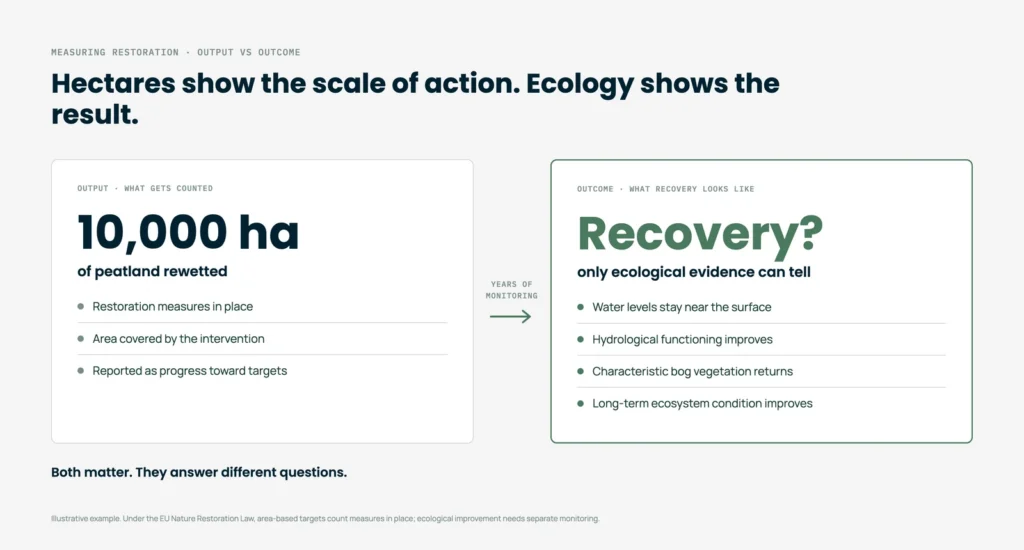
Suppose a country reports that restoration measures have been introduced across 10,000 hectares of degraded habitat.
What does that tell us?
It confirms the scale of intervention. But it does not necessarily establish whether the ecosystem is recovering.
For example, hectares of peatland rewetted represent an important restoration output. But understanding whether the intervention is improving hydrological functioning, vegetation communities and long-term ecosystem condition requires additional monitoring.
The Nature Restoration Law does include obligations relating to ecological improvement, not just the implementation of measures. Yet its area-based targets create a communication challenge: how can governments report progress without implying that restoration work completed is equivalent to ecosystem recovery achieved?
Both measures matter. They simply provide different kinds of evidence.
3. Establishing meaningful ecological baselines is complex
To know whether an ecosystem is improving, we need to understand its starting condition and what recovery could reasonably look like.
This sounds straightforward, but ecological baselines are rarely simple.
Historical records may be incomplete. Some landscapes have been modified for centuries. Climate change is altering the environmental conditions under which ecosystems function.
Defining suitable reference conditions and selecting meaningful indicators will therefore be an important part of implementing the law. What constitutes progress for a peatland may be very different from what constitutes progress for a forest, river or marine habitat.
The regulation establishes different monitoring obligations across ecosystem types, but translating these requirements into comparable, reliable datasets will require national authorities to combine existing reporting systems with additional ecological observations.
Satellite data can help monitor changes across extensive landscapes, while field measurements provide information about ecological characteristics that cannot be observed directly from space. The challenge is to use methods appropriate to the ecosystem and the questions being asked.
For a deeper explanation of baselines, environmental indicators and the difference between reported activities and demonstrated impact, see our article on ESRS and environmental evidence.
4. Funding and local participation will determine what happens on the ground
Restoration requires financial resources long before ecological improvements become visible.
Projects may involve land-use changes, infrastructure removal, long-term maintenance, monitoring and cooperation with landowners and other stakeholders.
Many of these costs are immediate, while environmental and economic benefits may emerge over much longer periods.
Funding is already a significant implementation concern. According to figures reported following the European Parliament’s October 2026 debate, the European Commission indicated that only around 15% of the €6.5 billion allocated through current EU regional funds directly to nature, biodiversity and Natura 2000 had been spent.
This figure relates to existing regional funding, not a dedicated Nature Restoration Law budget.
Nevertheless, it raises an important question: even where money has been allocated to nature-related objectives, what prevents it from reaching implementation?
The European Commission’s implementation guidance identifies several existing financing mechanisms, including LIFE, the Common Agricultural Policy, Cohesion Policy funds and the European Maritime, Fisheries and Aquaculture Fund. However, the regulation does not establish a dedicated funding instrument for every restoration obligation.
Yet identifying potential funding sources is not the same as securing sufficient, predictable funding for implementation.
This raises practical questions.How will restoration costs be shared? What incentives will encourage land managers to participate? Who will finance monitoring once initial restoration activities are completed?
The answers will differ across countries and ecosystems.
Local participation is equally important.Farmers, foresters, fishers, landowners and local communities are directly affected by restoration decisions. Their knowledge can help identify practical constraints, ecological changes and opportunities that national assessments may overlook.
Restoration is more likely to succeed when these stakeholders are involved in defining objectives and implementing measures, rather than being consulted only after decisions have been made.
The challenge is therefore not simply to mobilise more funding, but to connect financial resources, local expertise and long-term responsibilities in ways that make restoration feasible.
What do National Restoration Plans mean for restoration organisations and funders?
The Nature Restoration Law places its main legal obligations on EU Member States. But national authorities will not deliver all restoration measures alone.
Restoration organisations, research institutions, land managers, businesses and funders can all contribute to implementing national restoration priorities.
As plans are assessed and finalised, three practical implications deserve attention.
1. Existing restoration projects may contribute to national targets
Many organisations are already restoring wetlands, forests, rivers and other ecosystems across Europe. Some of these activities may align with the priorities identified in National Restoration Plans.
This creates an opportunity to connect existing restoration work with national objectives, avoiding unnecessary duplication and helping public authorities identify where relevant action is already taking place.
For restoration organisations, an important first step is to examine the priorities set out in their country’s plan and understand how their projects relate to the targeted ecosystems, geographical areas and restoration measures.
However, alignment should not be assumed. Whether a specific project can contribute to national reporting will depend on the applicable restoration obligations, national methodologies and how the authorities account for the measures implemented.
2. Project-level monitoring data could become more valuable
National authorities will need reliable information about where restoration measures are implemented, what activities take place and how ecosystem conditions change over time.
Restoration organisations often hold relevant information that public authorities may not have readily available, including mapped intervention boundaries, field observations, historical measurements and project monitoring results.
Making these datasets accessible and sufficiently well documented could help reduce information gaps and support national monitoring efforts.
This is already an area of practical interest. In October 2026, the European Commission’s DG Environment and CINEA organised a LIFE project meeting on mapping nature restoration, exploring how georeferenced project data could contribute to EU biodiversity policy and identifying gaps in existing information.
For organisations managing restoration projects, the implication is clear: documenting where interventions take place, how they are implemented and what monitoring evidence supports the results could make their work more useful beyond individual project reporting.
However, there is no automatic requirement for every restoration organisation to adopt a particular platform or provide data directly to the EU. The practical requirements will depend on national implementation arrangements and relevant reporting obligations.
3. National plans could help guide future restoration funding
National Restoration Plans are also intended to identify financial needs, potential funding sources and support mechanisms for implementation.
For funders, this may offer a clearer view of national restoration priorities, helping identify where financial support could address implementation gaps or complement public investment.
For restoration organisations, the plans may provide useful context for designing projects, building partnerships and identifying relevant funding programmes.
However, the plans should not be interpreted as guarantees of new funding. The availability of resources will depend on national budget decisions, existing EU programmes and future financing arrangements.
The opportunity lies in improving the connection between ecological needs, credible projects and available investment, rather than assuming that the regulation will automatically generate new financing.
For organisations and funders, the most useful questions to ask now are:
- Which national restoration priorities align with the ecosystems and landscapes where we work?
- What evidence do we already collect that could support implementation or monitoring?
- Where could partnerships with national authorities, research institutions or other restoration actors strengthen delivery?
- How can funding support not only restoration activities, but also the monitoring and long-term management needed for ecological recovery?
National Restoration Plans could become more than regulatory documents. If used effectively, they could help connect national ecological priorities with the organisations, knowledge and resources needed to address them.
How will we know whether the Nature Restoration Law is working?
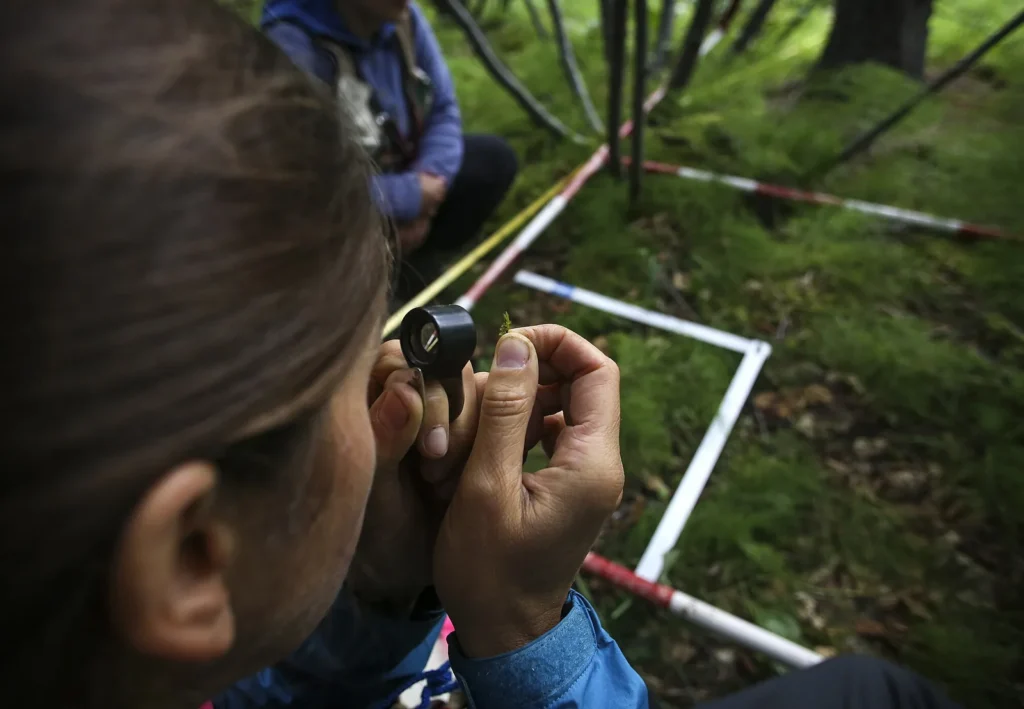
The regulation establishes a framework for implementing restoration measures and monitoring ecological progress. But its long-term effectiveness will depend on the evidence emerging from restored ecosystems.
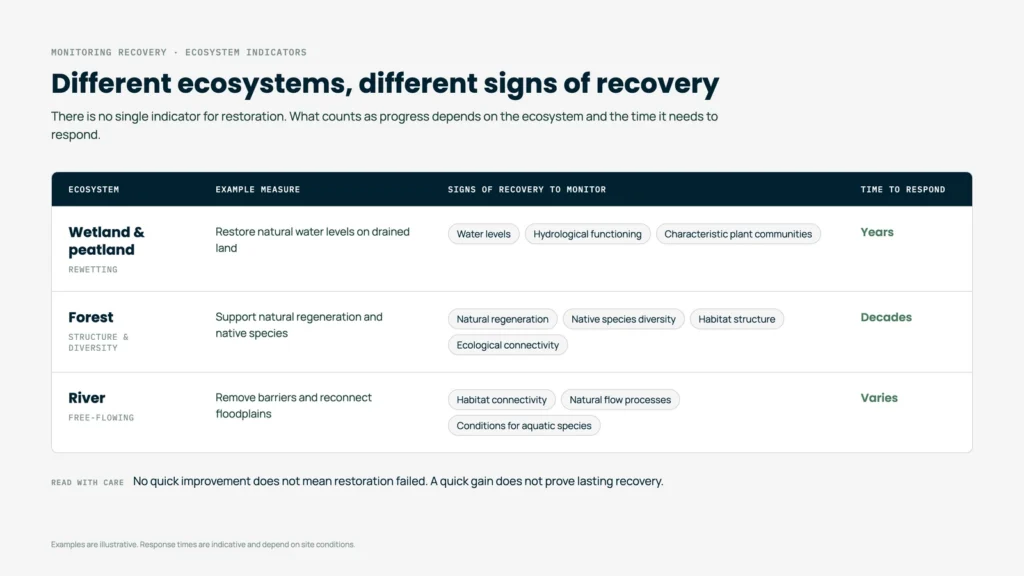
For a degraded wetland, progress might involve restoring natural water levels and recovering characteristic plant communities.
For a forest, it could involve improvements in natural regeneration, native species diversity, habitat structure and ecological connectivity.
For a river, it might mean reconnecting habitats, restoring natural flow processes and improving conditions for aquatic species.
These outcomes cannot necessarily be measured using the same indicators or over the same timescales.
A credible assessment therefore needs to account for ecosystem-specific objectives, appropriate reference conditions and the time required for ecological processes to respond.
A lack of immediate improvement does not necessarily mean that restoration has failed. Some ecological processes respond slowly. Conversely, rapid increases in vegetation cover or other indicators do not necessarily demonstrate lasting recovery.
The law creates a framework for tracking implementation and ecological conditions. But monitoring becomes particularly valuable when the information collected helps explain why restoration is succeeding, progressing slowly or failing to produce the expected results.
This is where adaptive management becomes essential. Ecological evidence should inform decisions about whether restoration measures need to be maintained, adjusted or reconsidered.
For restoration organisations and funders, the wider lesson is that credible evidence of recovery requires more than a single indicator or a snapshot of environmental change. It requires monitoring that is connected to clear restoration objectives and capable of supporting decisions over time.
What needs to happen next?
After the first national planning deadline, Europe’s restoration ambitions are entering a decisive implementation phase.
The European Commission will continue assessing draft National Restoration Plans, while Member States must refine their approaches and prepare final plans.
The first reporting milestones will provide additional information about implementation, but evidence of ecological recovery will develop over longer periods.
Several priorities will be particularly important.
First, national plans need to become operational. Clear responsibilities, realistic timelines, locally adapted measures and appropriate financing arrangements are needed to move from policy commitments to restoration activities.
Second, restoration organisations and national authorities need to connect their efforts. Existing projects, local expertise and monitoring datasets may help support national priorities, provided they meet the relevant ecological and reporting requirements.
Third, monitoring needs to support decisions, not just reporting. Establishing appropriate baselines, tracking ecological responses and responding to unexpected outcomes will help ensure restoration measures remain effective over time.
Finally, funding and progress need to be transparent. Restoration reporting should make clear what has been implemented, what environmental changes have been observed, what resources have been mobilised and where uncertainty remains.
These principles can help make restoration reporting useful not only for regulatory compliance, but also for improving restoration itself.
From legal targets to ecological recovery
The EU Nature Restoration Law represents a significant change in European environmental policy.
It recognises that protecting the ecosystems we have left is not enough. Restoring degraded nature must also become a shared responsibility.
Its ambition is important, and so are the obligations that give that ambition legal weight.
But legislation cannot restore an ecosystem on its own.
That work happens through decisions about land and water management, collaboration with local stakeholders, sustained financing and the gradual recovery of ecological processes.
The first national planning deadline has already shown how challenging this transition can be.
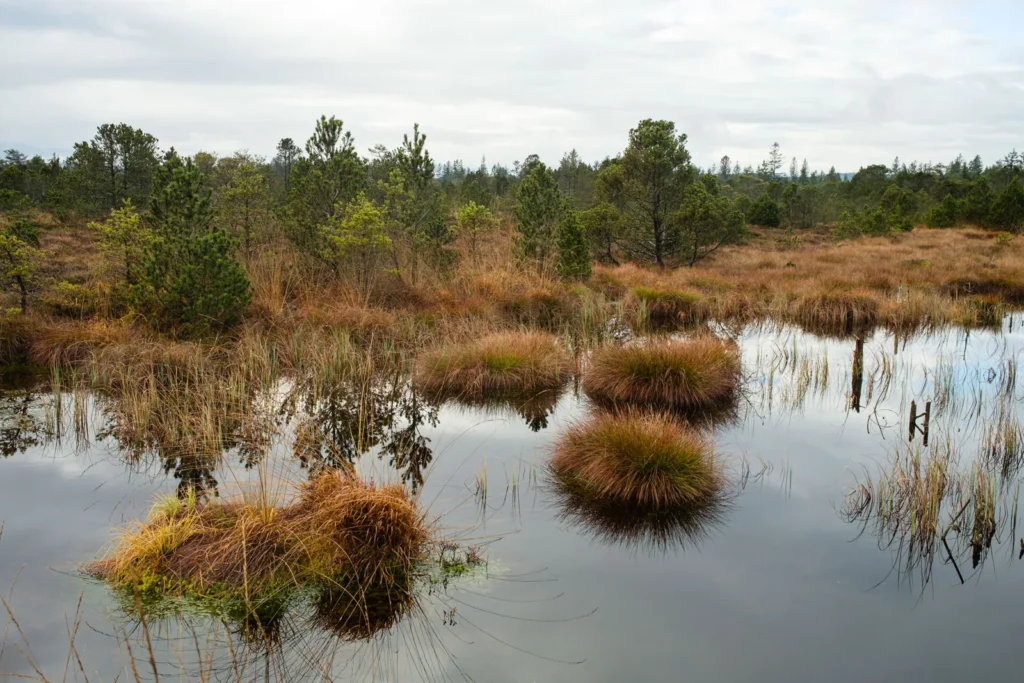
It has also highlighted an opportunity: to bring national restoration priorities closer to the organisations and communities already working to restore ecosystems, and to make better use of the evidence they generate.
Over the coming years, the most meaningful measure of success will not simply be how many hectares are covered by restoration measures.
It will be whether those measures lead to healthier, more resilient ecosystems, and whether we have the evidence to understand what is working, what is not and why.
The Nature Restoration Law establishes a common direction. Its success will depend on how effectively policy, funding, scientific evidence and practical restoration work come together.
Frequently asked questions
What is the EU Nature Restoration Law?
The EU Nature Restoration Law, formally Regulation (EU) 2024/1991, establishes legally binding requirements for EU Member States to restore degraded ecosystems. It covers terrestrial, freshwater, coastal, marine, agricultural, forest and urban ecosystems, with restoration targets extending to 2050.
When did the EU Nature Restoration Law enter into force?
The regulation entered into force on 18 August 2024. The deadline for Member States to submit their draft National Restoration Plans was 1 September 2026.
What is the EU’s nature restoration target for 2030?
The overarching EU target is to put effective, area-based restoration measures in place covering at least 20% of EU land areas and 20% of sea areas by 2030. The regulation also establishes more specific targets for particular habitats and ecosystems.
What are National Restoration Plans?
National Restoration Plans describe how EU Member States intend to fulfil the regulation’s targets and obligations. They include restoration needs, planned measures, indicative areas, monitoring approaches and financing information. Draft plans are assessed by the European Commission before Member States finalise them.
What does the Nature Restoration Law mean for restoration organisations?
Restoration organisations are not automatically subject to the regulation’s national planning obligations. However, their projects may contribute to national restoration priorities through implementation partnerships, ecological monitoring, data sharing or other activities. The opportunities and requirements will depend on each Member State’s plan and implementation arrangements.
Will the Nature Restoration Law create new funding opportunities?
National Restoration Plans must identify financing needs and intended funding sources. This could help guide future public investment and create opportunities for partnerships, but the regulation does not guarantee dedicated funding for individual restoration projects. Organisations should consult national funding programmes and relevant EU instruments as the plans are finalised.
Does the Nature Restoration Law require all ecosystems to recover by 2030?
No. The 2030 targets primarily concern implementing restoration measures across specified areas, alongside other ecosystem-specific obligations. The regulation sets longer-term targets for 2040 and 2050, recognising that ecological recovery can take considerable time.
How will progress under the Nature Restoration Law be monitored?
Member States must monitor and report on indicators specified in the regulation, including habitat condition and relevant ecosystem biodiversity indicators. Monitoring methods depend on the ecosystem and may include field observations, ecological assessments, remote sensing and other suitable approaches.
Does the law require companies to restore nature?
The regulation places its principal planning, implementation and reporting obligations on EU Member States. Companies and other private actors may be involved through national measures, land management arrangements, financing or partnerships. Their specific obligations depend on the applicable legal and national implementation context.
About OpenForests
OpenForests works with conservation and restoration organisations to turn environmental data into evidence that supports better decisions, transparent reporting and impact funding.
We help organisations define their Theory of Change, develop monitoring approaches and communicate ecological progress through spatial data, field observations and interactive tools.
Explore how OpenForests supports restoration monitoring and evidence-based decision-making