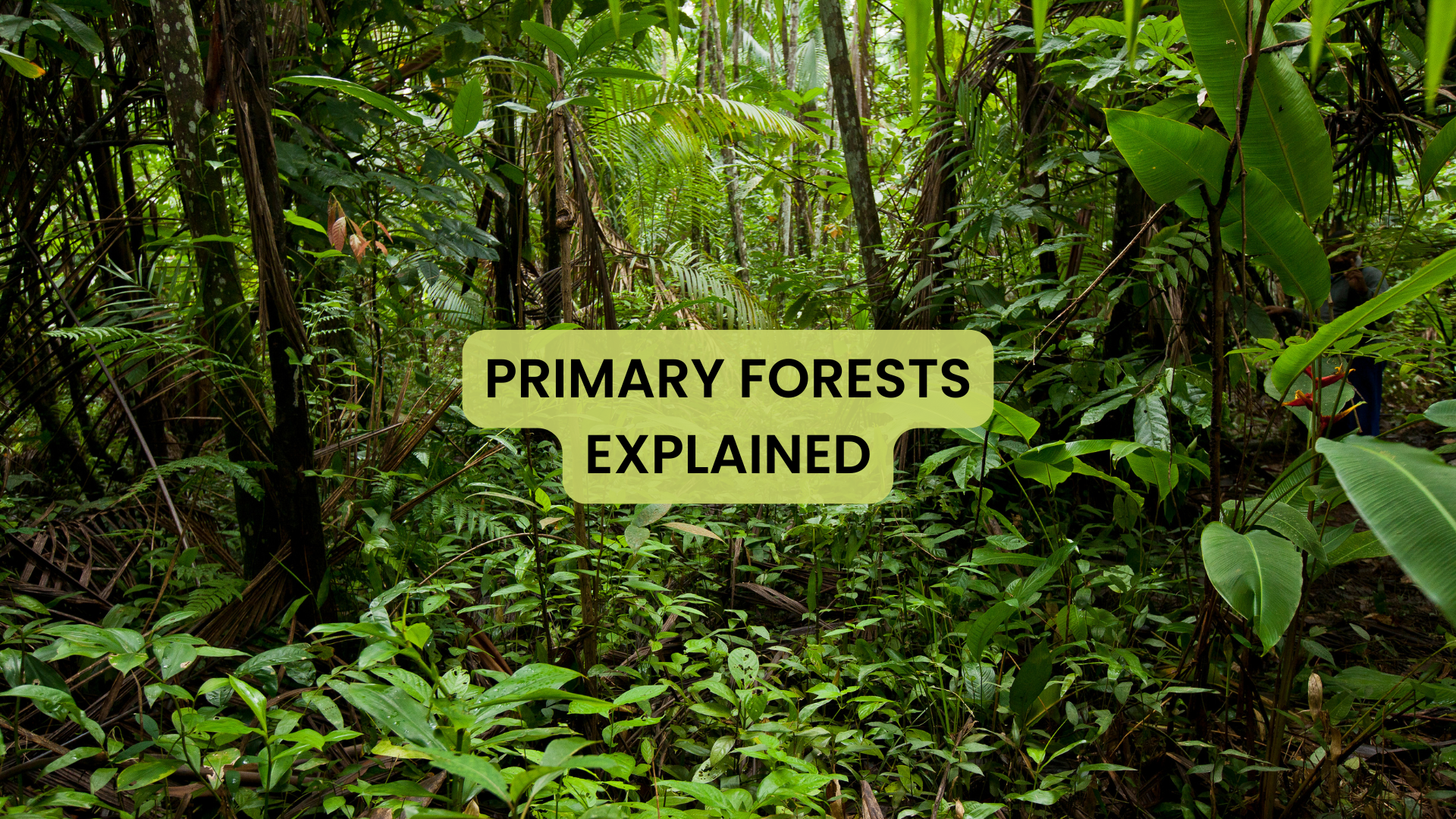
This article explores the meaning of primary forests, examines why these primordial forests are irreplaceable, identifies the places where they still survive, and asks the most pressing question of all: once lost, can they ever truly come back?
What are primary forests?
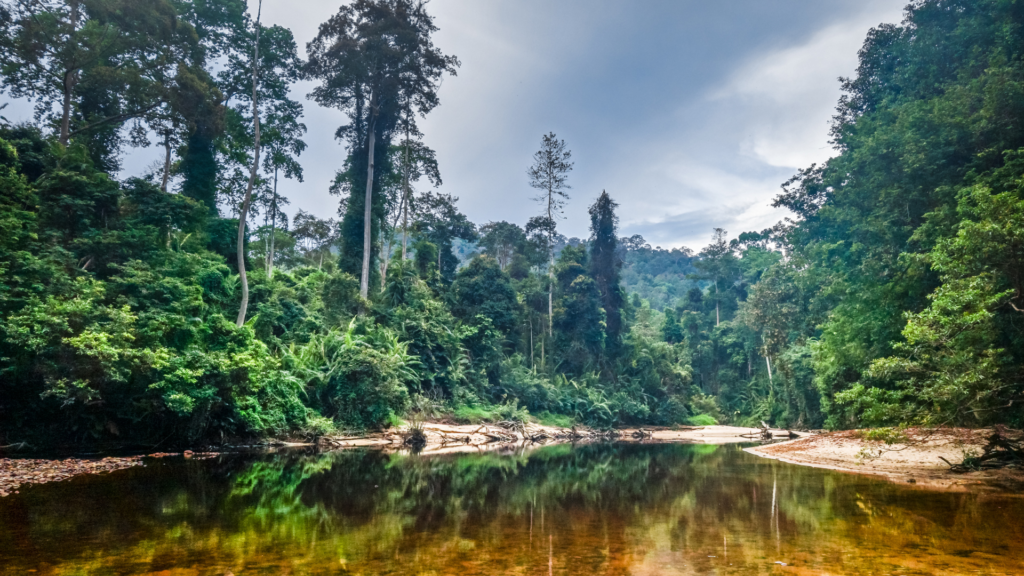
A primary forest — also called an old-growth forest, primeval forest, or primordial forest — is a naturally generated forest of native tree species that shows no clearly visible indications of human activity and where ecological processes are not significantly disturbed. This definition, used by the Food and Agriculture Organization (FAO) of the United Nations, captures the very essence of what distinguishes these ecosystems from all other types of forests on Earth.
Defining characteristics of a primary forest
Not every dense or ancient-looking forest qualifies as primary. Several specific attributes must be present:
No significant human disturbance. The defining criterion is the absence of substantial human intervention. A primary forest has never been logged at an industrial scale, cleared for agriculture, or subjected to systematic tree planting. Natural processes like fire, wind, flooding, or diseases may have shaped it, but human hands have not significantly altered its structure.
Complex, multi-layered structure. Primary forests develop a vertical architecture that takes centuries to form. The canopy, sub-canopy, shrub layer, and forest floor each host distinct communities of plants, fungi, insects, and vertebrates. This structural complexity is virtually impossible to replicate artificially within human timescales.
Abundant deadwood. Fallen trunks and standing dead trees (also known as “snags”) are characteristic of primary forests. This deadwood is a critical habitat for wood-boring beetles, hole-nesting birds, bats, and thousands of unique fungi and lichens. Managed forests almost always remove dead wood, which is one of the most obvious ecological distinctions between primary and secondary forests.
Find out more about the importance of dead trees: https://openforests.com/media/articles/dead-trees-forest/
Old, large trees. Primary forests are home to trees exceptional in age and diameter, which can be several hundred or even several thousand years old. These “veteran trees” provide unique microhabitats: cavities, loose bark, puddles in the canopy,and conditions that allow the development of epiphytes, which young trees cannot yet offer.
Self-regulating ecological processes. The nutrient cycle, seed dispersal, predator-prey dynamics, and natural disturbance regimes1 function without human intervention. The forest is, in the most literal sense, running itself.
Primary forest vs secondary forest: what is the difference?
The distinction between primary forest vs secondary forest is fundamental to understanding forest ecology. A secondary forest is one that has re-grown on land previously cleared or significantly disturbed by human activity. Secondary forests can be genuinely valuable for biodiversity and carbon storage, they are not the same as primary forests, and the difference matters enormously.
| Feature | Primary Forest | Secondary Forest |
|---|---|---|
| Human disturbance history | None significant | Previously cleared or logged |
| Age of canopy trees | Centuries to millennia | Generally decades |
| Structural complexity | Very high (multi-layered) | Lower (simplified) |
| Deadwood abundance | High | Low to moderate |
| Carbon stocks | Very high | Moderate and growing |
| Endemic species richness | Very high | Lower, recovering |
| Replaceability | Effectively irreplaceable | Recoverable over time |
Secondary forests can recover many forest functions over decades, but certain ecological features, particularly associated with old-growth structure and deadwood, take centuries to re-establish. This is why the primary forest vs secondary forest distinction underlies so much conservation policy and debate.
How many forests qualify as primary?
The question of how many primary forests remain is both important and complex. According to the FAO’s Global Forest Resources Assessment 2025, primary forests account for approximately 30% of total global forest area2, covering around 1.18 billion hectares. However, this proportion is declining. Between 1990 and 2025, an estimated 110 million hectares of primary forest were lost or degraded, the equivalent of losing a forested area larger than France and Germany combined or as big as Ethiopia.
By the numbers
Primary forests at a glance
Sources: FAO Global Forest Resources Assessment 2020; Global Forest Watch 2025.
Why are primary forests so important?
The importance of primary forests goes far beyond their beauty or their role as habitat for charismatic species. These ecosystems provide a range of ecological services that are essential to the functioning of the entire Earth system.
Biodiversity hotspots unlike any other
Primary forests ,and especially the primary rainforest biome found in the tropics, are home to the majority of Earth’s terrestrial species. Estimates suggest that tropical primary forests alone house more than 50% of all known plant and animal species3, despite covering less than 10% of the Earth’s land surface. The layered complexity of old-growth forest structure creates thousands of micro-habitats, each capable of supporting highly specialized organisms found nowhere else.
Many of these species are not just residents of primary forests. They are entirely dependent on them. Invertebrates that live only in ancient deadwood, lichens that grow only on the bark of centuries-old trees, and birds that nest only in old-growth cavities would vanish if primary forests disappeared. Secondary forests, however mature they may be, cannot replace these relationships within a reasonable time frame.

Climate regulation and carbon storage
Primary forests are among the most effective natural mechanisms for removing carbon dioxide from the atmosphere and locking it away in biomass and soil. Old-growth tropical forests store between 40% and 70% more carbon per hectare than secondary forests of similar tree cover4. The Amazon, the Congo Basin, and the forests of Southeast Asia together contain carbon stocks equivalent to decades of global fossil fuel emissions.
Crucially, primary forests are not just carbon stores: they are active carbon sinks. Intact tropical forests continue to absorb net carbon year after year. Recent research has shown, however, that tropical primary forest loss due to deforestation, fires, and fragmentation can flip these ecosystems from carbon sinks into carbon sources5, accelerating the very climate change that threatens them.
Key insight: A single hectare of primary tropical forest can store over 200 tonnes of carbon above ground alone. When that hectare is cleared, much of that carbon is released rapidly into the atmosphere , a process that cannot be reversed on any timescale relevant to current climate targets.
Water cycles and watershed protection
Primary forests act as giant sponges and atmospheric pumps. Their deep root systems stabilize soils, preventing erosion and allowing rainwater slowly seep into underground aquifers. Their canopies intercept rainfall, reducing surface runoff and flooding downstream. Perhaps most remarkably, large primary forests, especially the Amazon, generate their own rainfall through a process known as “flying rivers”: the mass evapotranspiration of water vapor that travels thousands of kilometres before precipitating elsewhere.
The disappearance of primary forests has measurable effects on regional rainfall patterns, river flow, and water availability for hundreds of millions of people living well beyond the forest boundaries.
Indigenous peoples and local communities
Primary forests are not only ecological entities, they are also home to millions of Indigenous peoples whose cultures, livelihoods, food systems, and spiritual identities are inseparable from these landscapes. Research consistently shows that forests managed or stewarded by Indigenous communities are among the most intact and biodiverse on Earth. Respect for indigenous peoples’ land rights and traditional knowledge is therefore not only a matter of justice, but also of conservation effectiveness.
Medicinal and scientific value
An estimated 25% of modern medicines are derived from or inspired by compounds found in tropical plants6, the vast majority of which grow in primary forests. Thousands of species in these ecosystems have never been studied by scientists, and many of them hold potential as sources of new medicines, materials, and solutions to problems we have not yet encountered. The loss of a primary forest species before it has been catalogued represents a permanent loss of opportunities.
Can primary forests be restored?
This question sits at the heart of some of the most important debates in conservation science and environmental policy. The short answer is both encouraging and sobering: forests can absolutely regrow after disturbance, but a true primary forest, with all the structural complexity, species assemblages, and ecological processes it contains, cannot be recreated on any timescale meaningful to human society.
What forest restoration can achieve
Secondary forests that are allowed to regenerate naturally can recover many forest functions over time. Studies conducted in tropical regions show that secondary forests can recover 80% of the carbon stocks of old-growth forests within 60 to 80 years following abandonment, and that species richness can recover significantly within a few decades7. These are genuinely positive findings that support ambitious global forest restoration targets such as the Bonn Challenge, which aims to restore 350 million hectares of degraded land by 2030.
Active restoration efforts like planting native species, removing invasive plants, reintroducing lost fauna, can accelerate recovery and bridge ecological gaps. In certain contexts, particularly when the seed bank and the surrounding intact forest provide source populations, natural regeneration can be remarkably rapid and effective.
What restoration cannot replace
Despite these promising results, restoration has major limitations when it comes to the value of old-growth forests. The structural characteristics that define primordial forests—ancient trees, dead wood accumulated over centuries, stable underground communities formed over millennia, close co-evolutionary relationships between species—cannot be replicated quickly. Even the most optimistic restoration timelines are measured in centuries, not decades.
Some species are simply unable to survive in younger forests, regardless of their structural restoration. Specialist deadwood invertebrates, old-growth fungi, and organisms with low dispersal capacity may never recolonize a restored site if the nearest source population is too far away— a growing problem as fragments of old-growth forest become increasingly isolated from one another.

The irreplaceability argument: prevention over cure
The ecological literature is clear on one point: protecting existing primary forests is vastly more effective and less costly than attempting to restore them afterward. Restoration is valuable and necessary, but does not substitute conservation. A policy framework that allows the destruction of primary forests on the assumption that restoration will compensate for this loss is ecologically unsustainable.
This is why leading conservation organisations, scientists, and international policy makers increasingly emphasise the concept of irreplaceability when discussing primary forests. These ecosystems are not merely “more biodiverse” or “more carbon-rich” than secondary forests in a quantitative sense: they contain ecological characteristics that cannot be re-engineered within any human policy cycle.
Agroforestry, rewilding, and the future of forest recovery
New approaches to landscape-scale restoration offer some reason for optimism. Rewilding initiatives that reintroduce keystone species (wolves, beavers, large herbivores) can trigger trophic cascades that accelerate ecological complexity in recovering forests. Agroforestry systems that integrate trees into agricultural landscapes can create habitat corridors connecting fragmented primary forest remnants. And growing recognition of the role of Indigenous-led conservation has prompted a re-evaluation of what restoration means in landscapes where human communities have been stewards of forests for millennia.
The most honest answer to whether primary forests can be restored is this: the forests can come back, in some form, given enough time and the right conditions. But the unique combination of species, structures, and processes that defines a primary forest— product of thousands of years of uninterrupted ecological evolution—represents a legacy that, once erased, is lost forever, beyond any realistic hope of human restoration.
In a nutshell: Restoration is essential and should be pursued with urgency and ambition. But no restoration programme, however well-designed, can substitute for the protection of primary forests that still exist. Prevention remains, by every ecological measure, the only effective strategy for preserving these irreplaceable ecosystems.
Where primary forests can be found around the world?
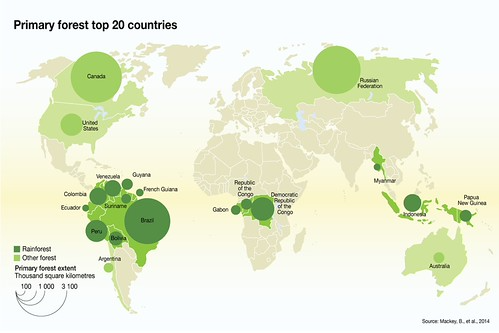
Primary forests are unevenly distributed across the globe. Their distribution reflects both the ecological conditions necessary for their development and historical patterns of human settlement and land use. Three countries account for more than 60% of the world’s remaining primary forest area: Russia, Brazil, and Canada.
Tropical primary forests: the Amazon and beyond
The most biodiverse primary forests on the planet are found in tropical regions. The Amazon Basin in South America is the largest remaining expanse of primary tropical forest, covering some 5.5 million square kilometers across Brazil, Peru, Colombia, and neighboring countries. The Amazon rainforest is home to about 10% of all species on the planet and plays a central role in the water cycle in South America and the global carbon balance.
The Congo Basin in Central Africa is the world’s second-largest tropical primary forest, stretching across the Democratic Republic of Congo, Republic of Congo, Cameroon, and Gabon. It houses forest elephants, okapis, western lowland gorillas and thousands of endemic plant species. Unlike the Amazon, it has so far escaped the most extreme rates of deforestation, although pressure is mounting rapidly.
Southeast Asia’s primary rainforests, found in Borneo, Sumatra, and Papua New Guinea, are among the most biodiverse on Earth but have also experienced some of the highest rates of tropical primary forest loss over recent decades, driven largely by palm oil and pulp paper plantations. Borneo alone has lost more than 40% of its primary forest since the 1970s.
Boreal primary forests
Beyond the tropics, the world’s most extensive primary forests are found in the boreal zone — the vast belt of coniferous forest stretching across northern Russia, Canada, and Alaska. Russia’s boreal forest, known as the taiga, is the largest terrestrial biome on Earth, covering approximately 800 million hectares. Large portions remain as intact primary forest, though logging, fire, and permafrost thaw driven by climate change are increasingly threatening their integrity.
Canada’s boreal forest — the world’s largest intact forest ecosystem — spans from Newfoundland to the Yukon and is home to woodland caribou, wolverines, and billions of migratory songbirds. While vast, it is not uniformly primary: significant areas have been logged, mined, or fragmented by roads and energy infrastructure.
Primary forest in Europe
Finding genuine prime forest Europe is challenging. Centuries of dense human settlement, agriculture, and industrial forestry have left Europe with very little truly primary forest. The continent’s old-growth remnants are small and fragmented.
The Białowieża Forest, straddling the border between Poland and Belarus, is one of the last and largest remaining fragments of primordial forest in the European lowlands. It is home to the European bison, lynx, wolves, and thousands of species of fungi and invertebrates dependent on ancient deadwood. Its status as a UNESCO World Heritage Site has not prevented ongoing political controversy about logging within its boundaries.
Other significant primary forest remnants in Europe include old-growth beech forests in the Carpathian Mountains (Ukraine, Romania, Slovakia), fragments in the Dinaric Alps (Croatia, Bosnia), and scattered ancient woodlands in Scandinavia. In total, primary or near-primary forests account for less than 3% of Europe’s total forest cover, a stark illustration of the continent’s long history of human land use.
Temperate and subtropical primary forests
Beyond the boreal and tropical zones, primary forests also survive in the temperate and subtropical regions of Chile (the Valdivian temperate rainforest), New Zealand (podocarp and beech forests), the Appalachian Mountains of North America, and parts of China’s southwestern highlands. These forests are often smaller in extent than their tropical counterparts but equally irreplaceable in terms of their ecological uniqueness and the species they shelter.
A fragile geography: The world’s remaining primary forests are concentrated in just a handful of countries and regions. This makes their protection simultaneously urgent and politically complex . The fate of the planet’s ecological heritage depends on the land-use decisions of a small number of governments and landowners.
Observe the Primary forests thanks to the Primary Forest Thematic Data layer on explorer.land: https://explorer.land/x/projects

Conclusion: protecting what remains
Primary forests represent something that cannot be manufactured, replicated, or substituted. They are the original archives of life on Earth, shaped by processes that began long before our species arrived and that will outlast us if we allow them to.
Understanding the primary forest meaning fully, not just as a legal or technical category but as a description of ecological complexity, time, and irreplaceability, is the first step toward taking their protection seriously. The contrast between primary forest vs secondary forest is not merely academic: it has direct implications for carbon accounting, biodiversity policy, water security, and Indigenous rights.
As tropical primary forest loss continues at alarming rates and as the question of how many forests qualify as truly primary narrows with each passing year, the decisions made by governments, corporations, consumers, and communities in the coming decade will determine whether these ecosystems survive to define the ecological landscape of the next century or become a memory of what the world once was.
Science is unambiguous: primordial forests of our planet are irreplaceable. The only meaningful path forward is to protect the primary forests that remain while restoring the degraded landscapes that surround them.
- Bousfield CG, Edwards DP. The pan-tropical age distribution of regenerating tropical moist forest. Nat Ecol Evol. 2025 Jul;9(7):1205-1213. doi: 10.1038/s41559-025-02721-8. Epub 2025 May 20. PMID: 40394200; PMCID: PMC12240804. ↩︎
- FAO. 2025. Global Forest Resources Assessment 2025: Main report. Rome. https://openknowledge.fao.org/handle/20.500.14283/cd6709en ↩︎
- https://theconservationfoundation.org/disturbance-regimes/#:~:text=A%20disturbance%20regime%20is%20the,severity%20that%20can%20be%20managed. ↩︎
- David Morales-Hidalgo, Sonja N. Oswalt, E. Somanathan, Status and trends in global primary forest, protected areas, and areas designated for conservation of biodiversity from the Global Forest Resources Assessment 2015, Forest Ecology and Management, Volume 352, 2015, Pages 68-77. ↩︎
- https://oldgrowthforestecology.org/ecological-values-of-old-growth-forests/ecological-processes-and-functions/carbon-sequestration-and-storage/ ↩︎
- Rodríguez-Veiga, P., Carreiras, J.M.B., Quegan, S. et al. Loss of tropical moist broadleaf forest has turned Africa’s forests from a carbon sink into a source. Sci Rep 15, 41744 (2025). ↩︎
- https://fsc.org/en/newscentre/general-news/forest-medicines ↩︎