What are wetlands?
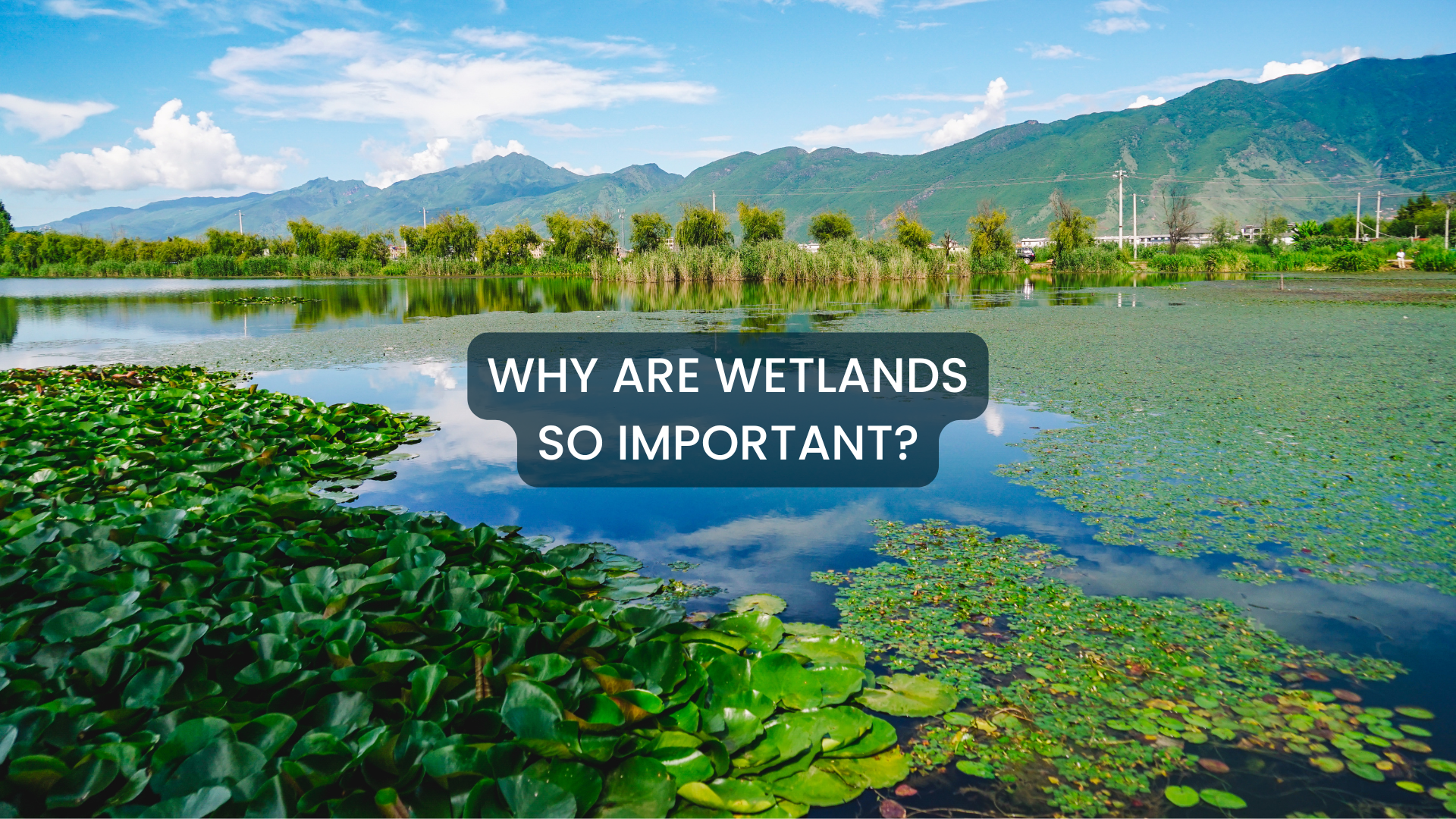
Wetlands are areas of land that are permanently or seasonally flooded. They vary in size and form and change with the seasons and over time.
Wetlands include a wide range of natural and human-made habitats. They can stretch over kilometres or, conversely, be very small, and exist in every climatic zone and altitudes, from coastal areas to high-altitude mountains.
They include coral reefs, swamps, lakes, mangroves, marshes, fens, mudflats, salt marshes, billabongs, peat bogs, or bodies of water and much more.
The water in these areas can be stagnant or flowing, fresh, brackish, or salty, and can include inland rivers and coastal or marine waters up to a depth of six meters at low tide.
You can even find underground wetlands.
Different types of wetlands often coexist within a complex ecosystem that is home to a wide variety of wildlife.

Why are wetlands important?
In addition to being home to numerous animal species, wetlands are essential to the health of our planet. Wetlands are among the most biologically diverse and carbon-rich ecosystems on Earth.
A key ally in tackling climate change
Wetlands act as natural carbon sinks, capturing and storing vast amounts of CO₂. Peatlands cover around 3% of our planet’s land and store approximately 30% of all terrestrial carbon, twice as much as all the world’s forests combined. As for mangroves, they absorb up to four times more carbon than other types of tropical forests.
On the other hand, when wetlands are degraded or destroyed, they release greenhouse gases, worsening the climate crisis and making ecosystems and the people who depend on them more vulnerable to the effects of climate change.
In addition, wetlands are the first line of defense for communities facing extreme weather events. Coastal wetlands, including mangrove forests and seagrass meadows, protect shorelines from storms and sea level rise. They physically slow them down by blocking their passage to the land and minimizing their total strength.
Wetlands also play a role in mitigating floods, absorbing significant amounts of rainwater and runoff.
Biodiversity hotspots
Wetlands support 40% of the world’s biodiversity. They are home to a variety of wildlife, from small organisms, amphibians, and fish, to apex predators such as sharks or more surprisingly, tigers. They are also essential habitats for migratory birds and to many endemic species that can only be found in a specific wetland area.
The loss and degradation of wetlands is threatening all of these species, pushing some of them to the brink of extinction.
Key figures:
- Since 1970, 81% of inland wetland species and 36% of coastal and marine wetlands species have declined.
- 25% of wetland species are threatened with extinction, including water birds, freshwater dependent mammals, marine turtles, and coral reef- building species.

A safeguard for water security
Without wetlands, there would simply be no fresh water, since almost all of the freshwater on Earth comes directly from them. Wetlands ensure water security by playing a critical role in purifying water, storing it, and helping to control flooding.
They act like natural filters, removing impurities, salt and pollutants from water. They also act like sponges, absorbing excess water during periods of heavy rainfall and slowly releasing it during periods of drought. They are a cornerstone of the water cycle, whose loss impacts not only biodiversity, but also the living conditions of humankind.
Acting to protect, conserve and restore wetlands is essential in the current context of water bankruptcy.

What are the different types of wetlands?
The diversity of wetlands is as great as the diversity of the places where they can be found. They vary due to factors such as hydrology, climate, topography, soil material, vegetation, geology, water type, and many others, making them unique visually but also giving them different functions in the ecosystems
Here, we’ll introduce you to the main types of wetlands found around the world.
Peatlands
Peatlands account for half of the world’s wetlands. Despite covering 3 to 4% of the earth’s surface, they contain twice as much carbon as the world’s forests.
They are characterized by a thick layer of waterlogged soil composed of dead and decaying plant matter.
Peatlands include moors, marshes, swamps, peat swamp forests, and permafrost tundra. They can absorb heavy rainfall and release water slowly, thus providing protection against flooding.

Mangroves
Mangrove forests are found in tropical and subtropical regions in tidal areas, meaning that they are subject to ocean tides and are regularly inundated with saltwater. They are among the most complex ecosystems on the planet.
Distributed across Africa, America, Asia and Australia, they occupy around 15.2 million hectares of tropical coast growing under extremely challenging environmental conditions.
Despite providing protection against extreme weather events such as storms, floods or heavy winds, they are in strong decline due to human activities.
This video by Ecosia illustrates how mangroves protect coastlines
The leaves and roots of mangroves are a source of nutrients for plankton, algae, fish, and crustaceans. Mangroves also compete with rainforests in terms of carbon storage potential.

Rivers and deltas
Perhaps the most familiar of the wetlands, rivers are natural watercourses flowing towards the ocean, a sea, a lake, or another river. They are formed by rain falling on high ground, then flowing down into valleys to form streams and waterways.
Deltas occur at the lower reaches of rivers. They are areas of slower-moving, shallow water that extend into vast wetlands.
Both rivers and deltas are home to a variety of fish, amphibians, and shellfish. Rivers are also important sources of drinking water, irrigation, and food. In addition, they are a source of energy and serve as transportation routes for commercial purposes.

High altitude wetlands
High altitude wetlands (HAWs) are found at altitudes higher than 3,000 masl1 (metres above sea level). They store water from glacier melt and rainfall, and feed groundwater stores, trapping sediments and recycling nutrients, thus improving the quality of water.
They are found as high as in the Himalayas, but also in the Andes, for example, where their best-known form is called “páramo.”
HAWs are essential stops on the migratory roads of many birds and also crucial breeding grounds for birds, fish, and amphibians.
Promoting vegetation growth, they reduce soil erosion and regulate water flow. This way, they ensure steady downstream flow and reduce the gravity of disasters such as landslides, floods, or droughts.
High altitude wetlands are particularly affected by the disappearance of glaciers.

Wetlands in dry regions
Wetlands also exist in arid and semi-arid regions. There, they are generally formed during the seasonal rainfall retaining their water over extended periods. These wetlands come in the form of rivers, lakes, swamps, and seasonal springs drying up a part of the year.
They can be found in Africa, Asia, Australia, North and South America, and the Middle East.
Dayet Er Roumi lake is a good example of wetland located in the semi-arid region of Khemisset, Morocco.
These wetlands located in arid regions are essential for farmers, livestock breeders, and the livelihoods of populations that depend on fishing and plant gathering. They are also important for millions of waterbirds that breed in Europe and Asia, such as herons.
You can find other types of wetlands such as estuaries, salinas, coastal lagoons, arctic wetlands or underground wetlands. They also play a vital role in their ecosystems and shape the relation between the wildlife, the fauna and their environment.
What are the threats to wetland ecosystems?
We have lost 64% of the world’s wetlands since 1900 and more than 35% since 19702, with the current rate of loss being three times faster than that of forests. Their disappearance is significantly harming many species, pushing some to extinction, as 40% of the world’s species depend in some way on wetlands.
The main driver of wetland destruction and degradation is human activity.
Changes in land use
The last few centuries have seen the drainage of hundreds of thousands of kilometers of wetlands in order to provide land for housing, agriculture and industry. But also due to deforestation and the construction of dams, ditches, drains, dikes, which altered their hydrology.
These transformations increased competition for water and caused habitat loss and wildlife decline.

Pollution
Pollution is another major problem for wetlands and comes in many forms: runoff of agricultural chemicals, industrial discharges, release of untreated waters, plastic waste, …
Plastic waste, often the first issue that comes to mind, is not necessarily the biggest issue. In wetlands like in the ocean or the river, it represents a danger especially to the wildlife, animal mistaking it for food.
But chemical runoff is even more insidious. Pesticides and fertilizers, among others, are washed away by rainwaters and carried to wetlands. There, they destroy the fauna and flora, either by killing them directly in the case of pesticides, or by excessively enriching wetlands with nutrients in the case of fertilizers (a phenomenon known as eutrophication).
Another major source of pollution are industrial discharges and the release of untreated waters.
80% of global wastewater is released into the environment without treatment3 containing all types of pollutants.
Many industries release waste directly into waterways then reaching wetlands. This waste can contain toxic chemicals, hydrocarbons, heavy metals… It poisons not only the waters but also the soils of wetlands, harming or killing the plants and wildlife.
All these forms of pollution pose serious threats to wetlands. But wetlands also play an important role in addressing those threats as they can act as natural filters, helping to remove pollutants from the water (sediments, metals, nitrogen, …).
Invasive species
The introduction of some foreign species can be extremely harmful to native species and their ecosystem. These species, called invasive non-native species, adapt easily to their new environments, where they thrive without natural predators, and outcompete native species for resources.
Invasive species tend to form monocultures or fields of only themselves which lower the biodiversity and resilience of the ecosystem.
Climate change
Climate change has many repercussions on wetlands. Changes in temperature, precipitation patterns and amounts, water chemistry, and projected sea level rise are all factors that impact wetland ecosystems.
Whether they deteriorate or dry up completely, this leads to the destruction of habitats that are vital for wetland species such as migratory birds, corals, and amphibians. It also exacerbates the effects of natural disasters such as floods, droughts, and forest fires.
Paradoxically, thanks to their carbon sequestration capacity, wetlands could be part of the solution to climate change. It is therefore essential to preserve and restore them.
What projects on explorer.land are protecting wetlands?
Many inspiring initiatives are working to protect and restore these ecosystems essential for climate resilience, biodiversity conservation, and the well-being of local communities.
Here are a few ones showcasing their impact on our platform explorer.land:
- Restoring Casamance Mangroves (Senegal) by WeForest https://explorer.land/x/project/weforest_casamance
- Aranta – Sotema Mangrove Restoration Project by ARC: https://explorer.land/x/project/arantasotema
- Solutionscape: Saving wetlands by Wyss Academy For nature: https://explorer.land/x/project/saving_wetlands
- Regenerative Development of Anlo Wetlands Project in Ghana by terraformation: https://explorer.land/x/project/anlo-wetland-project/sites
- Tulan Private Nature Reserve by Green Balam Forests: https://explorer.land/x/project/tulan/site/Tj1z8U/about
- Rehabilitation of the riparian area in Gambella by cetrad: https://explorer.land/x/project/rehab_gambella
At openForests, we support wetland conservation by putting these projects on the map and contributing to their transparency.

FAQ wetlands
You may have some questions left about wetlands. Here are some complementary information.
What are wetlands made of?
According to the Ramsar Convention, wetlands are defined as ‘areas of marsh, fen, peatland or water, whether natural or artificial, permanent or temporary, with water that is static or flowing, fresh, brackish or salt, including areas of marine water the depth of which at low tides does not exceed six meters’.
Where are wetlands located in the world?
There are wetlands on every continent except Antarctica. Swamps, mangroves, marshes, fens, freshwater, saltwater, brackish, they are essential ecosystems habitat for countless flora and fauna species. Wetland types are defined by the combination of plants and water sources that compose them.
By 2025, 2520 sites are designated Ramsar Sites covering 253,075,668 hectares4 .
Where are wetlands located in the world?
There are wetlands on every continent except Antarctica. Swamps, mangroves, marshes, fens, freshwater, saltwater, brackish, they are essential ecosystems habitat for countless flora and fauna species. Wetland types are defined by the combination of plants and water sources that compose them.
By 2025, 2520 sites are designated Ramsar Sites covering 253,075,668 hectares4 .
Where are wetlands located in the world?
There are wetlands on every continent except Antarctica. Swamps, mangroves, marshes, fens, freshwater, saltwater, brackish, they are essential ecosystems habitat for countless flora and fauna species. Wetland types are defined by the combination of plants and water sources that compose them.
By 2025, 2520 sites are designated Ramsar Sites covering 253,075,668 hectares4 .
What are Ramsar sites?
A Ramsar site refers to a wetland that has been designated as being of international importance under the Ramsar Convention. Also known as the “Convention on Wetlands,” the Ramsar Convention is an intergovernmental environmental treaty established in 1971 by UNESCO, which went into effect in 1975.
The list of Ramsar sites is dynamic. For a wetland to be included on this list, it must meet one or more criteria for identifying wetlands of international importance.
What are the 5 types of wetlands?
- marine (coastal wetlands including coral reefs, coastal lagoons and rocky shores);
- riverine (wetlands along rivers and streams);
- estuarine (including deltas, mangrove swamps, and tidal marshes);
- lacustrine (wetlands associated with lakes);
- palustrine (meaning “marshy” – marshes, swamps and bogs)
However, various classification systems have been developed over the years for different purposes by the Ramsar Convention, the USFWS (U.S. Fish and Wildlife Service) and other organizations and institutions, with different numbers of types.
Sources
1 https://link.springer.com/rwe/10.1007/978-94-007-6173-5_278-2