Intro
What does it really take to restore ecosystems at scale, beyond planting trees?
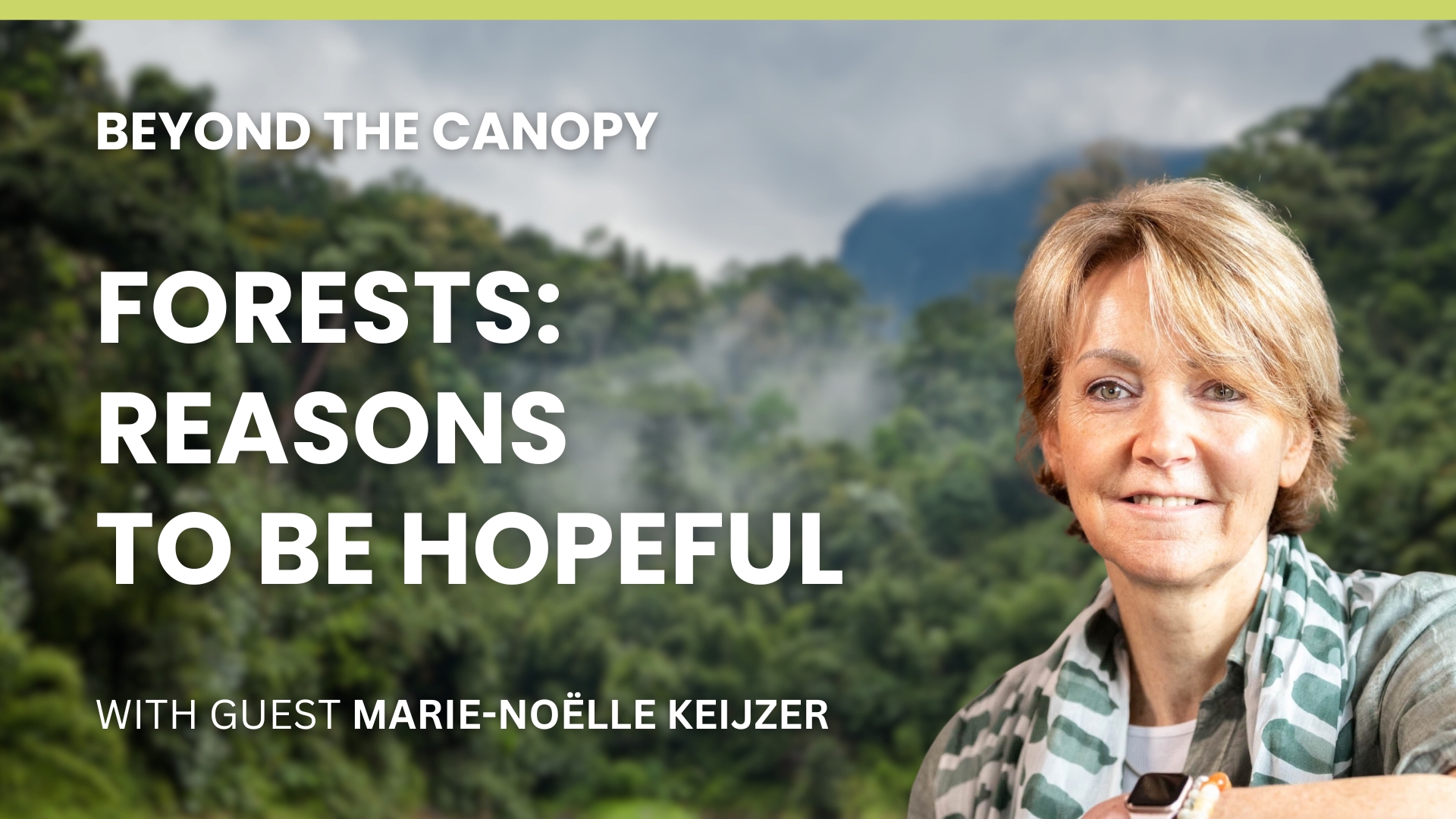
In this episode of Beyond the Canopy, we sit down with Marie-Noëlle Keijzer, CEO of WeForest, to talk honestly about the realities of ecosystem restoration. From restoring more than 80,000 hectares to planting over 100 million trees, WeForest’s work reaches far beyond forests, it supports livelihoods, strengthens communities, and builds long-term resilience for people and nature alike. Together, we explore what works (and what doesn’t) in large-scale restoration, why community leadership is essential, and how science, transparency, and integrity are non-negotiable if we want restoration to deliver real, lasting impact. We also discuss the growing role of corporate partnerships and how to make sure they truly support ecosystems rather than just good intentions.
The episode
About Marie-Noëlle Keijzer
Marie-Noëlle Keijzer, CEO and Co-Founder of WeForest, leads an organization that has restored more than 80,000 hectares and supported the planting of over 100 million trees, while going far beyond forests to strengthen livelihoods, empower communities, and build long-term resilience for people and nature.
Transcript
Alexander Watson (00:01)
Welcome to Beyond the Canopy, the podcast where we explore the most innovative approaches to ecosystem restoration and impact-driven investments. I’m your host, Alexander, and today’s guest is someone I’ve known for a long time, I guess more than 11 years. And I’m super excited to welcome Marie-Noëlle Keijzer. She’s the CEO of WeForest, which is an organization that has restored over 80,000 hectares, planted more than 100 million trees and supported and contributed to 100,000 families worldwide. But numbers alone don’t explain why WeForest has become a reference point in the restoration space, which is a sector that has struggled with credibility, scandals, and also greenwashing. Marie-Noëlle brings something out of the space. I would say it’s the deep system thinking, also a background that’s combined with a very grounded understanding of what it takes to make restoration work, especially in fragile and complex context. So Marie-Noëlle, welcome to Beyond the Canopy.
Marie-Noëlle Keijzer (01:11)
Thank you, Alexander, for the opportunity. Delighted to be here today with you.
Alexander Watson (01:16)
Yeah, likewise. A previous guest on this podcast, Tim Christopherson, who you also know well and joined the corporate space after a long career at the UN. And you did kind of the opposite way. You spent almost two decades at executive level in the corporate world, coordinating complex logistics, supply chains across many countries. And then something changed. Can you take us back to that moment? What happened?
Marie-Noëlle Keijzer (01:48)
That’s a nice question indeed. I’m sure most of you have seen the Inconvenient Truth from Al Gore, the documentary that came out in 2006, I believe. And that’s what made the big change in me. Indeed, I was very happy in the corporate world, enjoyed myself for two decades, as you said. Then when I saw that, I don’t need to tell the story of that, because I think everybody knows, I realized I had to do something about it. It started being so present, it being like a fixation a little bit. I went back to school actually during my period still in the corporate world towards the end, I went to night classes in Brussels and did a master’s in environmental science. So I believe you have to have the science and you need to be credible in whatever you do. So that’s what I did. And when I graduated, coincided with the stop of my corporate career, I started looking for something to do and this is where I met Bill Liao, my co-founder, who actually had already worked with a lot of scientists back in Australia and everywhere in the world on the role of forest for climate and for many other things. And so we came together and we decided to go on this adventure together. You had the vision, you had the contacts, and I had the energy and the time to focus on that and make it the reforest that we have today.
Alexander Watson (03:08)
Yeah, great. And what would you say can the environmental sector learn from the corporate space?
Marie-Noëlle Keijzer (03:16)
There’s so much, I how many hours we have. But basically, what I bring to the nonprofit sector is the rigor that you have in big multinationals where processes and tools are very important, efficiency is important. I think it has to go everywhere, including in the nonprofit, which is sometimes unusual because that’s not the focus of the nonprofits very often. But it is for WeForest and it has been from day one.
That dual experience for me made it quite simple and obvious to go to corporates, knock on the door and say, can you fund us? And so because I know their language, language is important, the way you communicate very clearly, very precisely. So all of this together made it very obvious that corporates would be our main funders. And that’s what they have been for the last 15 years. We have close to 500 corporates that have funded us today.
Alexander Watson (04:09)
Wow, that’s a big amount. So when you talk about WeForest, so initially WeForest acted more as an intermediary. So just channeling the funding from the corporate side to the global South. But at a certain point, I think you made a strategic decision, if I recall correctly, so that WeForest becomes like a direct implementer or a project developer yourself. Why was this shift specially necessary?
Marie-Noëlle Keijzer (04:39)
That’s also a very good question. Remember when I started, I just had this vision, I the idea and I had no funding and I no experience in forestry. I had a degree, a master’s in environmental science. With that, you don’t do what we’re doing today. So the logical step was to reach out to organizations that were already working in the field and planting trees and restoring landscapes across Africa primarily and ask them to work for us. And then I would indeed, as you said, be an intermediary with the corporate network that I was in touch with. We did that for a while. I wasn’t very happy with the result because I could not control the quality. Like when you have a subcontractor like that, you ask them and then they don’t, they just do what they do. They don’t follow you blindly because you’re not a big funder. So I had very little leverage there and I decided I had to control the quality.
I wanted to make every single donation transparent. That was number one for me. So from day one, we went into auditing our accounts, even though they were tiny at the beginning. Imagine the first year we got 35,000 euros. So it was tiny, but still everything’s audited. And then also we started working with OpenForests to map every single polygon transparently to the funder. Because when you work in an organization like ours, the only thing a funder gets is the trust is,
the certainty that you’re having an impact and where you’re having an impact. And that’s a factor that’s for one funder is not being funded by another one at the same time. That’s so obvious that for me, it was a no brainer. We had to do that. So that’s where I started to hire people. And the countries that we started developing are still today the biggest focuses that we have in Africa, which is Zambia with the Myanmar countries around and also Ethiopia, obviously, which is the biggest country we have today.
Alexander Watson (06:36)
So when we talk about success metrics, so many organizations still claim success by counting trees planted. You do it also, but you have been very clear that trees alone do not make a forest. So why is counting trees not enough? So I think we’re measuring many, yeah, like biomass, survival rates, soil carbon, indicators, but…Why is just counting the trees not enough?
Marie-Noëlle Keijzer (07:09)
Well, first I want to say that talking about trees, there’s nothing wrong with it. Trees are the most incredible creature we know. It does so many good things for the planet and I can list, I don’t need to say it here. think everybody who’s watching already knows the incredible benefits of planting trees, growing trees and protecting nature. So there’s nothing wrong with that. But the work that we do in the places where we work is so much more complex. So yes, you can summarize it in number of trees and
And some brands and companies are happy with that because they want to connect a tree with a product. And so you count the tree. But really to be fair to the work that we do, you need a lot of other metrics. And like you just said, we measure the growth of trees. not just the number of trees, but the growth of trees, the survival rate of the trees. We measure soil, the quality of the soil. We measure the water retention in the soil.
The biodiversity changes. Also the work that we do, we do it with and for the communities. So communities are at the center of what we measure. When we arrive in a landscape, as we call it, that is in a region that we are planning to restore over 10, 15 years, which is the duration of the programs that we start. We first do a baseline, a baseline of nature and a baseline like how many trees and is it, it, are there still some seeds there or is it totally barren?
We also do a baseline on the people who live there. How many families live there? How many single mothers live there? What’s the poverty level of people? Who gets priority in the livelihoods that we do? So all of that is then measured against results and progress to see that we are really making a difference. So the KPIs that we measure are very numerous and they’re the only way to know that what we’re doing has a real impact.
Alexander Watson (09:01)
Yeah. And I also picked out one example of WeForest where basically landscapes are restored without planting trees, for example, in Zambia’s dambos. think it’s not so many people find this counter intuitive but sometimes it seems that not planting trees can be the best ecological choice, right?
Marie-Noëlle Keijzer (09:24)
That’s also a great question. You see, the best tree is the tree that’s been there forever. An ancient tree that you want to protect. So basically you would prefer not to have to plant any trees. We have to plant trees because we have to sequester additional carbon to reduce the carbon pollution that we have. We have to restore what we have lost. So we have to plant trees, but ideally you protect first, then, if you have a degraded area, you make sure it doesn’t get more degraded and you try to make it regenerate naturally. The species that will grow there, they will be very solid because they will be totally adapted and they will sprout naturally. So they will be resistant to climate change and to the difficult conditions. And the third option, especially when you have no seeds left in the region, that happens in some areas. We see that a lot in Brazil, but we see that everywhere that the soil is so poor, there are no seeds, then you do need to have active planting. So there’s really a graduation of first protecting, then natural regeneration, and then active planting.
Alexander Watson (10:30)
Yeah. And I think also in an interview you mentioned why some ecosystems don’t need trees because afforestation in those areas is not the natural way of the vegetation. So if this is like a grassland ecosystem, it does not make sense to plant trees, even though they might grow there for a certain period of time, but then they shade out the understory and make the soil prone to water and erosion. yeah, as you mentioned really in the beginning, it’s super important when planning such a project to do a thorough assessment and baseline study to really see what are the right elements in that place.
Marie-Noëlle Keijzer (11:11)
Indigenous trees and plant Indigenous trees as well. It’s a cool tech science. Forest trees not just planting a tree.
Alexander Watson (11:14)
And it also includes, I think, the people. if you plant indigenous trees people don’t want or don’t use, in some cases it might also sense, for example, that you plant cinnamon trees or other fruit trees that provide additional services, which might not be supernatural, but help people to get an income and avoid fuel wood or other reasons for deforestation.
Marie-Noëlle Keijzer (11:46)
Yeah, you bring up an interesting point is there’s many different ways of doing reforestation. Indeed, you can plant in an area where it’s totally degraded. You can also work with the farmers who in most of the countries where we work have little plots of land and that you help regenerate with trees that are directly going to bring them income. That’s what we call agroforestry. And so we play with that mosaic of solutions in order to meet the community’s needs.
Alexander Watson(12:19)
Yeah. And I think the Desa’a project is also an interesting example where you basically, as I recall correctly, you started with doing restoration and then a crisis appeared, a political crisis appeared. There was a war and then you had to totally shift your support to the community.
Marie-Noëlle Keijzer (12:42)
Yeah, that’s a good example, Alexander, of how you have to be committed to the communities to really succeed in this field. If you’re just doing this for yourself, then might as well do something else because it is difficult. And in order to succeed, you need to work with the community. So indeed, let’s take that example, the Desa’a project that we have in the northern part of Tigray in the northern part of Ethiopia. That project is our flagship project. It is 38,000 hectares that we are protecting and restoring, but impacting a landscape, so communities around, of around 150,000. So that’s 150,000 hectares. And the people who live there, they’re 23,000 families. So you can count multiply by six or something, you’ve got 110,000 people that live there, that live with us, that work with us. So we’ve been working on this project village by village during several years. And then all of a sudden, as you said, a civil war between the federal government in Ethiopia and the Tire State. And that lasted for two years. The banks were closed, the schools were closed, transport, nothing happened. People were just living in autarky. USAID funding, which was very important for these communities because they were very, very poor, went away. So there was nothing left but us because our team lives in Mekele and that’s what they do. They work with the community. So actually they call us and say, guys,
We can’t plant any trees because nothing’s happening, but we need to help these people. They rely on us. And so that was a big question for us because we don’t do humanitarian support. That’s not what we do. We’re not good at that. Well, we still did. We raised a million euros and also put 300,000 from our savings to buy for every single family that we were working with, 50 kilos of wheat and 50 kilos on barley. And those seeds were brought in by truckloads.
We had special authorizations. can see my guys who are normally foresters, like pushing the truck drivers to come in, going through the controls at the border of the state to deliver those seeds on time for the farmers to plant and feed their families for the following year. That’s what we achieved. And I can tell you how the community loves our team, but that’s what we consider commitment. We do whatever it takes basically.
Alexander Watson (15:04)
And also if, let’s say in the restoration space, people speak about permanence. just in terms, for example, of carbon, that carbon stays in the landscape, they often considering fires or calamities. But I think the biggest, let’s say insurance is the social trust that you can build with the communities in those locations, right?
Marie-Noëlle Keijzer (15:27)
And that indeed they are, the guards are the people from the community, the people work in the nurseries, very often disabled or old people working in the nurseries to grow the seedlings. And then the families participating, benefiting, for example, in Desa’a, it’s a very interesting project. It’s not just about trees and forestry. It’s also about retaining water and avoiding erosion. Because that is one of the last regions in this Eastern Afro-Montane biodiversity hotspot touching the Sahel is part of the Great Green Wall because it is becoming a desert. So it doesn’t rain much, but when it rains, it rains a lot. And when it rains a lot, it washes all the topsoil and then nothing’s left for trees to grow or for food to be cultivated in the gardens. one of our main target there is to really create check-downs in the rivers and dig holes to retain water so the trees can sprout. A third of our budget goes into soil preparation and to avoid that also the water reservoirs of those communities get silted with mud and then they can’t drink anymore. So we also did that. The community asked us to fund big machines to go and clean the big water reservoirs because they didn’t have clean water anymore. That’s the kind of commitment you take when you enter such a landscape. And that’s what makes us happy, actually.
Alexander Watson (16:54)
Yeah. I think that’s a super nice example of a really deep partnership. it also reveals that, so we discussed this tree planting model. not planting many trees automatically becomes a forest and the forest becomes a landscape. So there are different components. There’s the terrain. There are the people. There are lot of environmental factors like when does it rain? Does the rain stay in the landscape? Or as we have seen in Sri Lanka, just washes down the tea mountains and everything with it. really, let’s say, building this close relationship on a landscape level is, think, where I would say that WeForest is also standing out. I do not want to go into a rhetoric question, but I want to spend a few minutes on, let’s say, the restoration market we have seen in the past years, specifically become space, tree planting, double accounting, failed projects, broken promises. So a lot of things have happened and harmed also the reputation of the market. But today, WeForest has managed to a reputation based on trust. Maybe you can explain a little bit what WeForest has done different than maybe other organizations in that space.
Marie-Noëlle Keijzer (18:27)
You know, I would like to come back on this episode where a lot of critiques have been written on reforestation projects, on carbon projects. In any environment, in any ecosystem, you have rotten apples, have people that are crooks that come in business to make money. And we see that everywhere. doesn’t, it’s not specific to our industry. So the problem I find is that we go totally taken out of proportion and it inundates the media. Obviously we see that a lot because we share that in our ecosystem. It hurts a lot because when you see how hard it is for the people to do the work that for my team to do the work that we do, it’s not a ride in the park. It’s super hard. You’ve got, first you have to raise the money, which is not easy these days. You have to work in environments that are remote. Some of my people take a whole day to get to a project in difficult roads, dangerous roads. You have the local complexity of the governments. You have rains and you have droughts and you have difficult situations where there’s mortality you can’t prevent. So it’s super complex to work with nature. I mean, try it out when you plant something in your garden and the plants die. In spite of that, we have amazing results. For example, in Ethiopia, we have a 90 % plus survival rate. But nevermind, what I want to say is, it’s very easy to sit back and critique. And so when these articles came from The Guardian, think it’s so easy to critique, then come up with a proposal, come up with an alternative. If you don’t have an alternative, then just be quiet because that really can upset me. I think the world would be better off if people would have some sympathy, some understanding and try to look for what’s good in what’s happening as opposed to what’s wrong.
Alexander Watson (20:19)
It’s also an easy excuse. So you say, this is all carbon cowboys. I don’t need to care about it.
Marie-Noëlle Keijzer (20:25)
The result is that then it’s shrinking, then less commitment and companies are afraid of… sometimes they do things but they don’t say it anymore, which is crazy. It’s crazy. People should be proud of doing good.
Alexander Watson (20:37)
Yeah, of course I see big corporates are holding back in the space and they also have fears that a misstep could lead to reputational damage, for example, if these are big brands. So that’s, I think, their main concern there.
Marie-Noëlle Keijzer (20:54)
You said something before you talked about greenwashing earlier in the discussion, and I want to say something about greenwashing. know, greenwashing is never what you do. Whatever you, even if you plant one tree, planting just one tree or funding just one tree, it’s never been greenwashing. It’s the story you tell about it, that it could be greenwashing. So that’s how we advise our partners as well. So don’t be afraid of being ambitious, doing things, and then we’ll help you communicate powerfully so that you are covered. And if anybody critiques, you are safe because that’s our role as well. We’ve been around for 15 years. We’ve worked with 500 organizations. We’re the biggest Belgian NGO in reforestation. So we know how to support our partners. So I would say there is no green washing except if you lie or if you tell something that is far from reality, that’s it.
Alexander Watson (21:44)
Yeah, totally agree. So maybe I try a little bit complicating question. So I know you speak a lot of languages and I also learned that you have an environmental science master and in business administration. So you also speak the language of ecology and business. So you work with a lot of businesses and help them to understand the subject of landscape restoration, nature-based solutions. So you help to translate what they can do in that field. And my question is: when you do that, let’s say, to, let’s say, package nature in metrics, in trees, in families, whatever. So is there also like a risk reducing the real value of nature? So how do you balance this?
Marie-Noëlle Keijzer (22:42)
Are we commoditizing?
Alexander Watson (22:45)
Exactly. That’s a better term.
Marie-Noëlle Keijzer (22:47)
Yeah. I get you. And that’s the question I ask myself. I’ve seen that happening with carbon. I fear that this could be happening with biodiversity. And to be honest, I think it doesn’t do nature favor, commoditizing these products. And then you attract people that just come for the money and don’t do quality. That’s the risk of this. We have one carbon certified project, another one that’s potentially going to be carbon certified in order to sustain long-term protection. That’s how we use carbon certification. So it’s a little bit different than most organizations use, but really in the relationship with corporates, you say, try to pitch what we do. Actually, we listen to them and listen to what they’re trying to achieve. What does every company want to achieve actually is having happy clients, having happy employees. If you demonstrate that you are committed to doing good, that you are acknowledging your employees by involving them in choosing a project that they want to support, for example. And I see many companies in our network have that. Some of the biggest projects and partnerships that we have come from employees who’ve suggested to their management, hey, you should work with WeForest. That’s amazing. I can name UCB, which is a big pharma in Belgium, 12 year commitment in Desa’a. That’s amazing. And coming from the employees. So that’s what every CEO wants to achieve. Your clients, you want them to be happy. Yes, you also want to tick the boxes of the legal reporting, but basically fundamentally you want to work in harmony with nature. You want to restore what maybe you have degraded because of your economic activities. And that’s the language that I speak to the corporates that I meet. I’m not so much into this whole carbon and stuff. I’m more like back to basics. And this is how we have developed incredible partnerships that are lasting over 10 years. Like we are with Nike Europe for over 10 years. Brabancia, a Dutch company that so many of you know, they have developed something incredible with us. They started planting one tree for every rotary dryer that they were selling.
It is incredible what it brought to them because first it created, it developed a culture of wanting to do more. And now they are a circular company, know, cradle to cradle, with a neutral, carbon neutral building, like doing incredible things. So from starting small, planting one tree with us for every rotary dryer, doing very good business, they grew a total different culture. Also business-wise, it made a lot of sense. Their business of these dryers was growing 23 % year on year, whereas the market was overwhelmed with Chinese competition.
Alexander Watson (25:45)
Wow. So really contributed to their top line growth.
Marie-Noëlle Keijzer (25:51)
Totally. So it’s like, and then telling a candid story, just very simple. On the dry, on the product, you could see the tree, the logo of WeForest and the story, and just people standing in the store, they saw a cheaper product and they saw one that was doing good. Most people took the one that did good. So I think we can do that. And then it would be painless. We could restore the planet that we need because we do need to act now. We don’t need to just pay lip service to it. We don’t need to just make nice CSR reports. We need to act. We need to restore the forest that we have degraded. We’re still losing the equivalent. I have some statistics actually, which I take out of an incredible book that I would like to mention. It’s this book, Not the End of the World by Hannah Ritchie. She’s a data scientist in our field and it’s incredible what she explains, very positive. think everybody should read that. Basically, if I summarize between 2010 and 2020, we lost the equivalent of twice the size of Spain in forest. But the good news is that we restored once the size of Spain. So what we’re saying is we’re losing, but we are recovering. And so that’s the work that some of us do. Plus also it’s important to know that deforestation as we have known it in the past has peaked in the 80s. So now it’s still not good.
still pretty bad. There’s some years that are even worse like 2024 because of the fires. But basically, we are doing better than we were before. And this is important. We need to give positive messages to inspire people.
Alexander Watson (27:33)
Yeah, I totally agree. So when you explained you’re listening to the corporates, to the employees, what they really want to achieve. So my question is, is this like a mutual process because they say, we want to save these sweet panda bears or something like that, but you need the money to build dams in the Desa’a Project so that the water is not running off, which is not so sexy than these little sweet animals.
Ideally are unrestricted funding, but realistically, yeah, you have to be creative and do like a core, let’s say educational process and with these organizations to make, to explain them, well, we have to install the dumps that the people can make living there and not cut down the forest. And then finally the sweet animals will survive. So my question is how do you form the dialogue and what kind of information are these corporate clients or customer partners expect in terms of reports, storytelling? So what do they get for it? So when they give you the paycheck.
Marie-Noëlle Keijzer (28:44)
Yeah, that’s very interesting because as in nature, diversity works. You don’t want corporates to all be the same and they’re not the same. And in nature, it’s the same. You need diversity. Every company has something different. If they are active in water or they have a big consumption of water, they might want to look at the water impact. If they are wanting to say, want to plant a tree for every employee, is there something great? Or if they’re more nature because of their impact. So every company develops their own culture and what they care about. And the projects that we develop are so holistic that everybody can find something. People that care about people and to fight poverty. People that support women empowerment. Because WeForest is a women led, not just at my level, but in the whole organization, we have many women in leading positions and we focus on women. And as I said before, we prioritize also women with children, single mothers. So basically everybody can find something good in the project that we do. that’s the wealth, that’s the diversity.
Alexander Watson (29:50)
Yeah. And maybe we can also say that, let’s say the world of corporates is also a portfolio, like an ecosystem. So with different interests, with different desires and you help, say, yeah, you mentioned up to 500 corporates to match, make their desires and their fulfillment and doing something meaningful in the world, connecting them to the right places within these project components.
Marie-Noëlle Keijzer (30:17)
And what excites me in working with Corpus is that Corpus, you just said, are an ecosystem by themselves already. They’ve got suppliers, they’ve got customers. And that’s something we continue to work on is if all the ones that we directly work with were sharing widely what they do with their own ecosystem, imagine how quickly we would resolve this. This is already, for example, back to Brabantia.
That’s what they also do. They always talk about WeForest. They always share that. They ask their partners to fund us. And that’s amazing because that’s how you really scale.
Alexander Watson (30:55)
Yeah. Yeah. I think it’s also interesting how we, us from the beginning on, open the book, open the maps and share what they do with their clients. So we as OpenForests, we are also super proud to work with you as a technology partner for such a long time. And I think together we have built also quite unique system where corporate contributions are not talking about it and inviting them to join, you can show each corporate contribution where it is located, down to the project, down to specific location. And you can see it in a satellite time-lapse. You have remote sensing data. have people, the rangers on the ground who take photos from the trees when you grow back, like a wildlife corridor in Brazil. So you can see every few years the trees are growing. I think some NGOs would be really scared about this kind of disclosure. But I think in your case, it also changed the way how you could speak about this with funders, right?
Marie-Noëlle Keijzer (32:09)
I know, Alexander, this has been our strength, looking back, the values on which we created our organization, partnership, integrity, courage. That’s what we manage our teams through those values. And that’s what transpires in everything that we do. And back to integrity, I think if we don’t bring integrity in what we do, we might as well go home and do something else.
It’s just, there’s nothing without integrity. And so indeed the transparency that you just mentioned is so obvious. Of course we’re going to have open books and everything we do. We do our best. Not everything’s perfect, but our ambition is to always get better. And I think we’re doing pretty well.
Alexander Watson (32:51)
For me, it’s really a nice philosophy to also take the funders onto like a joint journey and not just selling an impact product to them. So they, as you also described with this Brabantia, that they become part of the journey. They helped to transform the project on the ground. And likewise, these ideas, these inspirations, they get through the project also transform their own business and make it successful.
Marie-Noëlle Keijzer (33:23)
Also, we don’t take many funders to our projects because we feel we’re not a travel agency and it would defeat the purpose. Like I know of other organizations that do that as a business model to take their funders to the projects and stuff. It’s very nice. It’s very friendly. It’s fun, but it’s not responsible considering the footprint and you you fund the 10,000 trees and then you go and spend a week or two biking in some countries. I think this is not our model basically. But the few that have gone and visited the projects, they’ve loved it. just were, you know, and that’s what some funders that are big funders, very credible that I’ve worked with many others very often, you know, or in this case in Ethiopia, said they’d never seen a project like that. And that gives us, you know, assurance and we feel we’re on the right track.
Alexander Watson (34:10)
Yeah, it’s just an anecdote. had a funny conversation at a conference with the founder of Renature and they building also agroforestry project and they got like a decent funding, let’s say 20,000 from a consulting firm. And then the consulting firm asked if they can visit the project. And he said, yes, of course, but you have to pay the farmer like 5 to 10,000 euros. And then they asked why we donated to them? Yeah, because it’s not a zoo. I like this approach, It’s of course a little bit provocative…
Marie-Noëlle Keijzer (34:45)
it has to be proportionate. It needs have integrity. It doesn’t have integrity to just spend a few euros and then decide to go there. At least that’s not what we do because it doesn’t resonates.
Alexander Watson (34:58)
Yeah. I had one section I quickly want to touch with you. So you’re piloting biodiversity credits in Zambia. And I see also there’s a lot of hype around this new biodiversity market. And my question to you would be, we already ready for these biodiversity credits?
Marie-Noëlle Keijzer (35:22)
don’t think so. We’re not really piloting a biodiversity credits. think we are watching what’s happening and we need to see, but we know the projects that we do are very rich in biodiversity. Indeed, how do you measure that? Do we need to measure that so that companies that have a biodiversity footprint want to compensate? I haven’t spent much time on this. As I said before, I don’t want to commodify forests too much. I think there’s many other ways. To do that and to be contributing to the projects without having the very complex lengthy ⁓ process of certifying. When you look at this, the carbon market has generated so many jobs for consultants, for certifiers and so much money for them. That’s all money that’s not going to the projects. So you could argue that they will create more income for the projects. Maybe, maybe not.
Organizations are fighting for the same resources, scarce resource that know how to certify. Small NGO doesn’t have the bandwidth, doesn’t have the funding to do that. So it is already eliminating the smaller ones. It is putting a lot of money into people that are not really adding value to growing a forest. I have second, I mean, yes, it works some extent if we’ve done well, but that’s not the one solution, one model fits all.
I think again, we need to have diversity and not every project needs to be carbon certified. every project needs to be biodiversity certified. just needs to be corporates and other funders need to know the organization they’re working with. They need to trust the organization and then you don’t need any third party verifier to charge and double the price of the project because that’s what we’ve seen. Carbon certification doubles the price of the project.
Alexander Watson (37:13)
Yeah, I think I saw some statistics about carbon credit and how the revenues are split. so just a small fraction really went to the ground. Of course, there’s a lot of work to be done by the project implementers in terms of all the certification, biocracy, but the majority then at the end ⁓ ends up with the carbon brokers or the corporates that make the margin.
Marie-Noëlle Keijzer (37:39)
That’s a concern. So we think we’re channeling money to nature. We’re just making some consultants richer.
Alexander Watson(37:46)
Creating new commodities that can be sold in the finance.
Marie-Noëlle Keijzer(37:49)
So we need to go back to basics. That’s a little bit the call for action. Let’s just think smart. If as a company you have 100,000, 500,000 money that you think instead of doing a big event and spending all of that, maybe I can do something good. I can spend that on an NGO that has roots on the ground, that does a real impact with communities that need it, then consider that.
Alexander Watson (38:13)
Candidly. So we’re slowly coming to an end, but of course I reserved some hopefully interesting question. I know you want to scale the impact of WeForest beyond WeForest and become a model that ideally is copied by many other organizations. So what is your strategy so that comes true and what role play in this context, for example, organization like you supporting the art of forest and think you’re founding member of it or the one trillion tree initiative. So maybe you can give me a take on that. What possibilities you see to scale the restoration space, maybe with the support of corporates.
Marie-Noëlle Keijzer (38:50)
Yeah, that’s a nice closing question indeed, Alexander. WeForest indeed our dream is that we will be copied many times because that’s what the world needs. It’s not about us. We’re just facilitating, showing the way. But even if we were growing twice, know, multiplying our impact by two every year, it wouldn’t be enough for the needs of this planet. And we wouldn’t be going in all the countries. There are some countries that you could just come to that. So we’re doing our best and we’re trying to inspire others and we’re still looking at ways to share our knowledge. And we haven’t yet finalized that, but that’s something that we have in our mind, how to train new people that can copy us and that can replicate. The other action that I’m doing a little bit on the side of WeForest is indeed joining other groups. Like you mentioned, Art of Forest, which is a coalition of, think, 200 peers that work together, share best practices. I think this is amazing because that’s very rare in an industry that people come together. And the other one is the one T.org from World Economic Forum where a lot of corporates are pledging for us, which I think is important. I’m also working with scientists on pitching the science because I think the main thing is we need to stop talking to ourselves. All of us, we keep talking to ourselves all the time and we love talking to ourselves, but it doesn’t make any difference. So eventually we need to come out of the woods and speak to people so people hear us and people act because all the people on the street, it’s all the companies that are not yet engaged that need to join us and all the government, they need to support us and the philanthropists. And so that’s something that I’m driving as well with some interesting focus on the water cycle, which is something we were talking a lot about the carbon, but we need to talk about the water because when you think about it, all of us, we directly impacted in our daily life by water, water for drinking, water, for quality water, for enough rain, for not too much rain, all of that can be regulated by nature. And we’re forgetting that and we need to put nature in the center so that we can choose our future. What is the future that we want for our children?
Alexander Watson (41:00)
Yeah. Yeah. So in the sense of what gives you hope and how can you give hope and advise young generations? So what and where shall they start?
Marie-Noëlle Keijzer (41:15)
You know sometimes people ask me whether I’m optimistic or pessimistic for example which is connected to your question and I don’t ask my question that question very much. I’m just acting. I feel like taking action is the best remedy against uh despair when you see that we are damaging our planet. On the other hand you we can turn that around. we can transform that and it’s actually fun to do and it’s it’s incredible because I must say I feel privileged to work with organizations that are all committed to a better world because then you really speak and exchange with people at a different level in a very positive way. So that gives me hope that gives me a lot of energy and the same for my team. So focusing on something good whatever it is because the world needs forest but the world needs a lot of other good things and so I think all of us to reflect to be committed and to supporting good causes I think that’s the way forward whatever the good cause is actually.
Alexander Watson (42:17)
And as you explained it’s more fun it’s more fulfilling and rewarding at the same time. So imagine working at a corporate your entire life optimizing supply chains to to make the shareholders richer or optimizing um for impact for for better more equal. So I think that’s yeah it’s something that that certainly would agree to.
Marie-Noëlle Keijzer (42:40)
I just want to share something that happened in September with one of the big corporates that supports us. They created a climate week and they invited different speakers during every day during the whole week and WeForest was the last one on that Friday and there was a huge attendance and the employees just love it and I think that’s also important right to uh give the employees an opportunity because you said you know sometimes you’re in a job and it’s very routine and stuff well you can bring some light into people’s lives by connecting them back to nature and to causes that matter.
Alexander Watson (43:15)
Okay. Yeah, is there anything you want to let our listeners know?
Marie-Noëlle Keijzer (43:20)
I just wanted to thank you for organizing this discussion and for sharing it because indeed it doesn’t make a difference if we do great things and we don’t let people know.
Alexander Watson (43:27)
Yeah, we’re going to share this broadly, hopefully. So, Marie-Noëlle Keijzer, thank you very much for your leadership, your clarity for proving that restoration at scale is possible when it’s built on science, systems and trust. And to our listeners, quality restoration isn’t about planting many trees, it’s about staying, measuring, learning, being accountable and doing it again.
Thank you for listening to Beyond the Canopy and have a great day.