Key Highlights
- A Miyawaki forest is a small, densely planted patch of native trees and shrubs, designed to reach forest-like maturity in 20 to 30 years instead of a century.
- The method can pack hundreds of native trees into a plot as small as six parking spots, planted at up to five trees per square meter.
- Benefits include faster canopy growth, higher biodiversity potential, and measurable cooling during heatwaves, but a 2025 review in the Journal of Applied Ecology found several widely repeated claims still lack rigorous long-term evidence.
- Miyawaki forests are one specific technique within the broader category of urban forests, and shouldn’t be confused with the wider network of city trees, parks, and gardens.
Walk through most cities today and you’ll notice how little room is left for nature. Asphalt spreads, temperatures climb, and during a heatwave the gap between a shaded street and a bare one can be several degrees1. Urban planners, schools, and even homeowners are responding with a surprising ally: a forest smaller than a tennis court.
Known as a Miyawaki forest, this planting method packs hundreds of native trees into tiny plots, growing faster and denser than a typical woodland. It sounds almost too good to be true. So what is a Miyawaki forest exactly, does the method live up to its reputation, and how do you find one near you? Let’s dig into the roots of this movement, its real benefits and limits, and how transparent mapping helps separate promise from proof.
What is a miyawaki forest, and where does the name come from?
The Miyawaki forest meaning traces back to one person: Akira Miyawaki. This Japanese botanist spent decades studying the forests that once surrounded temples and shrines across Japan, remnants of vegetation left largely undisturbed for centuries. He noticed these sacred groves were far richer and more resilient than the managed pine plantations found elsewhere in the country. That observation became the seed of a planting method meant to recreate, in a few decades, what nature usually needs a few centuries to build.2
Miyawaki built his method around a concept called potential natural vegetation: the plant community that would grow in a given place if human disturbance stopped tomorrow. Before a single sapling goes in the ground, practitioners study local soil, climate, and any remaining native flora to work out which species actually belong there. The result is not a random collection of trees chosen for their appearance. It’s a tailored, layered plant community built to reflect the ecosystem a specific patch of land would host on its own.
What is the Miyawaki forest planting method?
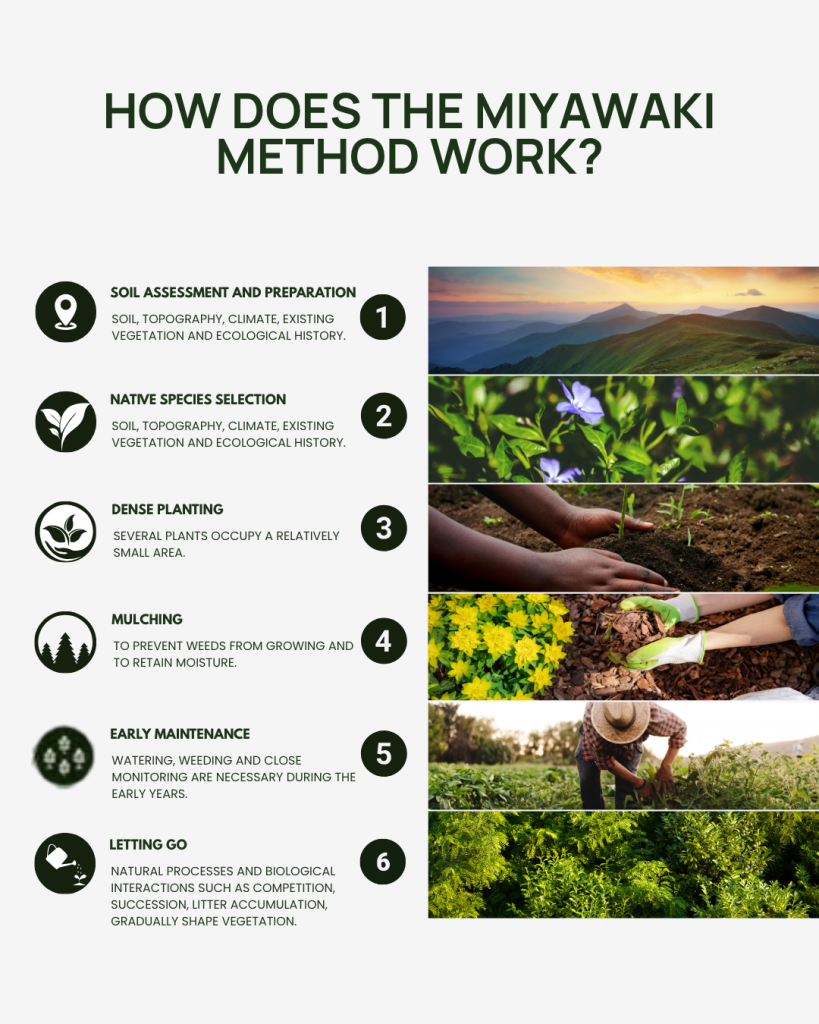
Once the target vegetation is identified, the Miyawaki forest planting method tends to follow a fairly consistent sequence:
- Soil assessment and preparation. Soil gets tested and often amended to loosen compaction and add organic matter, since urban soil is rarely forest-ready on its own.
- Native species selection. Local botanists choose a wide mix, often 20 to 50 species, spanning canopy trees, sub-canopy trees, shrubs, and ground cover.
- Dense layered planting. Saplings go in extremely close together, sometimes three to five per square meter, far tighter than conventional forestry spacing.
- Mulching. A thick layer of organic mulch suppresses weeds and holds moisture while the young forest gets established.
- Early maintenance. Watering and weeding stay intensive for the first two to three years.
- Letting go. After that window, the forest is meant to fend for itself, with competition between plants driving rapid, self-sustaining growth.
Another key feature of the Miyawaki method is creating multiple layers of vegetation by planting species to form the canopy, the understory, shrubs, and ground cover.
The tight spacing pushes young trees to race each other for light, which is the mechanism behind claims that Miyawaki forests mature many times faster than conventionally spaced plantings.
What are the advantages and disadvantages of Miyawaki forests?
Like any restoration technique, the Miyawaki method has genuine strengths and open questions.
Benefits
- Biodiversity boost. Because the method relies on native species planted in layers, it can quickly build the habitat structure insects, birds, and small mammals depend on.
- Urban forest cooling. Dense tree cover shades surfaces and cools the surrounding air, a mechanism confirmed across multiple studies of urban green space3.
- Heatwave relief. Even small, well-placed patches of vegetation measurably lower local surface temperatures during extreme heat, offering real relief in neighborhoods with little other shade4.
- Pocket forest efficiency. The dense design means meaningful green cover can fit into leftover urban spaces, an old car park corner or a disused sports field, sites too small for conventional forestry.
- Health and wellbeing. Nearby tree cover has been linked to measurable improvements in residents’ mental and physical health, adding a human dimension to the ecological case5.
Limitations
- Cost. The intensive soil prep and species diversity involved make a Miyawaki forest considerably more expensive per hectare than lower-intervention restoration approaches.
- Evidence gaps. A recent review published in the Journal of Applied Ecology examined dozens of Miyawaki studies and found that several widely repeated claims, including faster growth and higher carbon storage, still lack rigorous, long-term data to back them up6.
- Maintenance intensity. The first years demand consistent watering and weeding, a commitment volunteer-led projects sometimes underestimate.
- Scale limits. A pocket forest doesn’t replace large, intact forest ecosystems and the species that depend on them. It complements them.
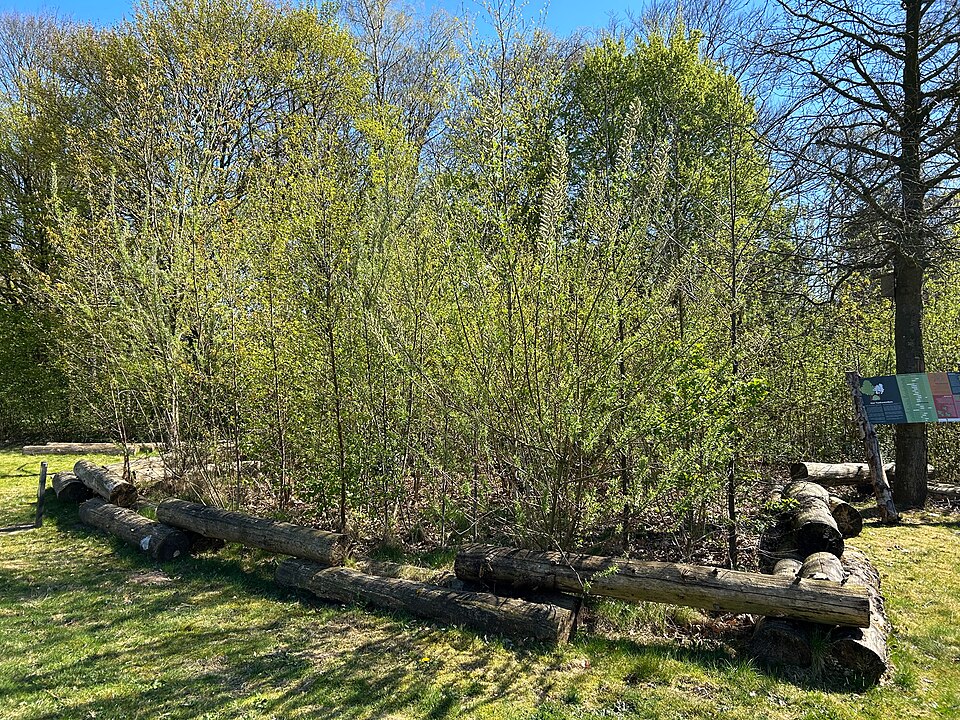
What makes a Miyawaki forest different from a regular urban forest?
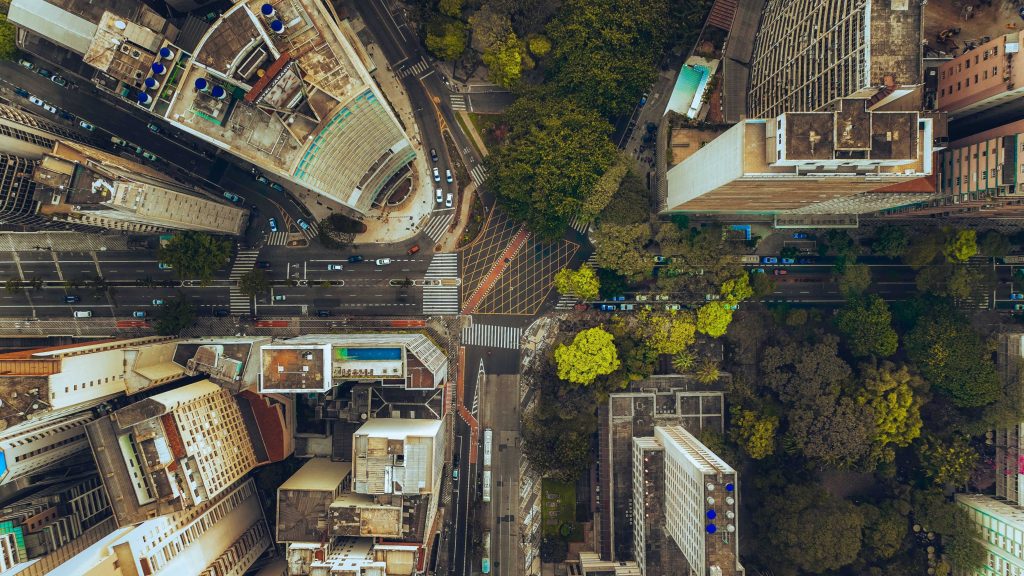
It’s easy to lump the two together, but they aren’t quite the same thing. An urban forest, as defined by the UN Food and Agriculture Organization, covers all the trees in and around a city: street trees, park groves, private gardens, even a lone tree outside a corner shop7. It’s a broad, often loosely managed network that builds up over decades through many separate, small decisions.
A Miyawaki forest is a specific, engineered version of that idea: a small, densely planted patch designed to mimic a mature native ecosystem in a fraction of the usual time. Think of it less as a park and more as a deliberately compressed woodland, planted with intent, then largely left alone to grow wild. Every Miyawaki forest is technically part of a city’s urban forest, but not every patch of urban forest follows the Miyawaki method.
Where can you find (or start) a Miyawaki forest near you?
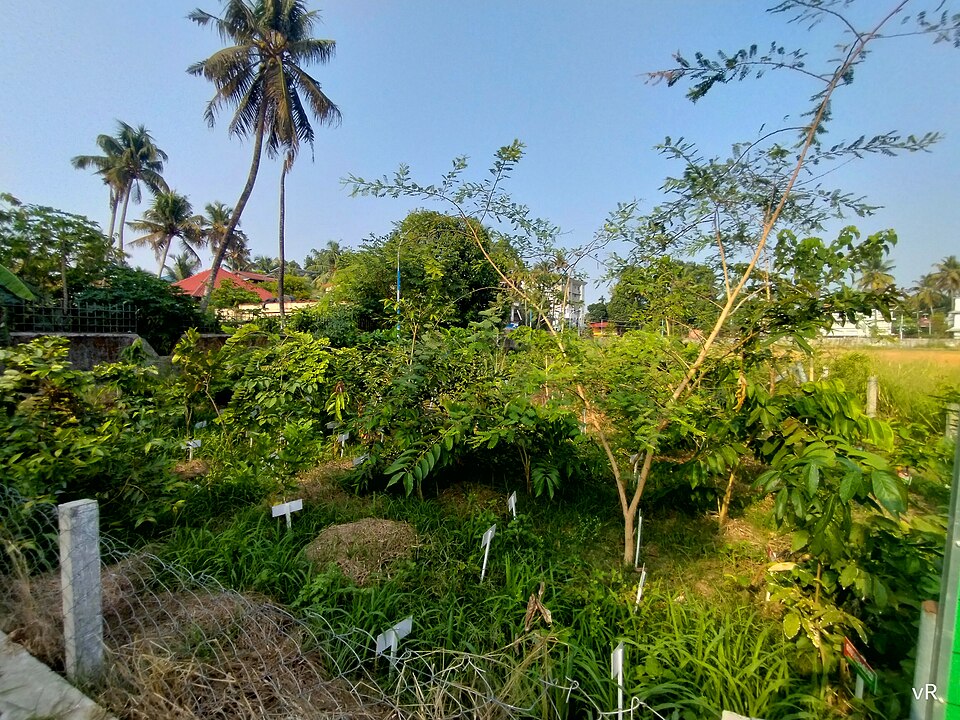
The good news is that you don’t need a city budget to bring one to life. Miyawaki forests have taken root in schoolyards, church lots, backyard corners, and reclaimed industrial land across several continents. Common starting points include:
- School grounds, where students take part in planting and long-term monitoring as part of environmental education.
- Municipal land, especially unused lots, roadside verges, or old sports fields.
- Private gardens, where homeowners convert part of a lawn into a miniature native woodland.
- Corporate campuses, often tied to biodiversity or carbon commitments.
If you’re trying to find a Miyawaki forest near you, local environmental associations, botanical gardens, and city sustainability offices are usually the best starting points, alongside community tree-planting networks that track where projects have taken root. And obviously, in our digital era, many projects have websites where you can find information.
How do you know a Miyawaki forest planting is actually working?
This is the question that matters most, and the one too often left unanswered. A newly planted Miyawaki forest looks like a patch of sticks poking out of mulch. Whether it becomes the resilient, biodiverse ecosystem it promises depends on years of care, monitoring, and honest reporting, not on the planting day photos alone.
This is where transparency matters as much as the planting itself. At OpenForests, we help restoration and conservation projects turn intentions into evidence, combining satellite-based monitoring through explorer.land with hands-on consultancy in impact measurement.
Our interactive map explorer.land lets restoration organizations show, over time, what’s actually happening on the ground, tree survival, canopy growth, soil health, species return, tracked across months and years rather than captured in a single before-and-after photo.
Conclusion
The Miyawaki method won’t single-handedly solve the climate crisis, and it won’t replace the ancient forests we’ve already lost. But as a way to bring dense, native, quickly established green cover into cities that badly need it, especially as heatwaves grow longer and harsher, it earns its place in the toolkit. The real work, and the real proof, starts after the trees go in the ground.
Curious what active restoration and rewilding projects, Miyawaki forests included, actually look like once the shovels are put away? Explore verified projects on explorer.land and see the data behind the trees.
Footnotes
- World Meteorological Organization, Atlas of Mortality and Economic Losses from Weather, Climate and Water-related Hazards (1970-2021). https://wmo.int/publication-series/atlas-of-mortality-and-economic-losses-from-weather-climate-and-water-related-hazards-1970-2021 ↩︎
- Miyawaki, A., “A Call to Plant Trees,” Blue Planet Prize Commemorative Lecture, The Asahi Glass Foundation. https://www.af-info.or.jp/blueplanet/assets/pdf/list/2006essay-miyawaki.pdf ↩︎
- Wei, Y. et al., “Multidimensional characteristics of urban green space and its impact in mitigating urban heat island effects,” Scientific Reports, Nature. https://www.nature.com/articles/s41598-025-23773-7 ↩︎
- Wei, Y. et al., “Multidimensional characteristics of urban green space and its impact in mitigating urban heat island effects,” Scientific Reports, Nature. https://www.nature.com/articles/s41598-025-23773-7 ↩︎
- “Urban Trees and Human Health: A Scoping Review,” National Library of Medicine, PMC. https://www.ncbi.nlm.nih.gov/pmc/articles/PMC7345658/ ↩︎
- Morales, N. et al., “Is the Miyawaki method for forest restoration effective? A global perspective,” Journal of Applied Ecology, British Ecological Society. https://besjournals.onlinelibrary.wiley.com/doi/full/10.1111/1365-2664.70242 ↩︎
- Food and Agriculture Organization of the United Nations, “Urban and Peri-urban Forestry.” https://www.fao.org/forestry-fao/urbanforestry/87025/en/ ↩︎