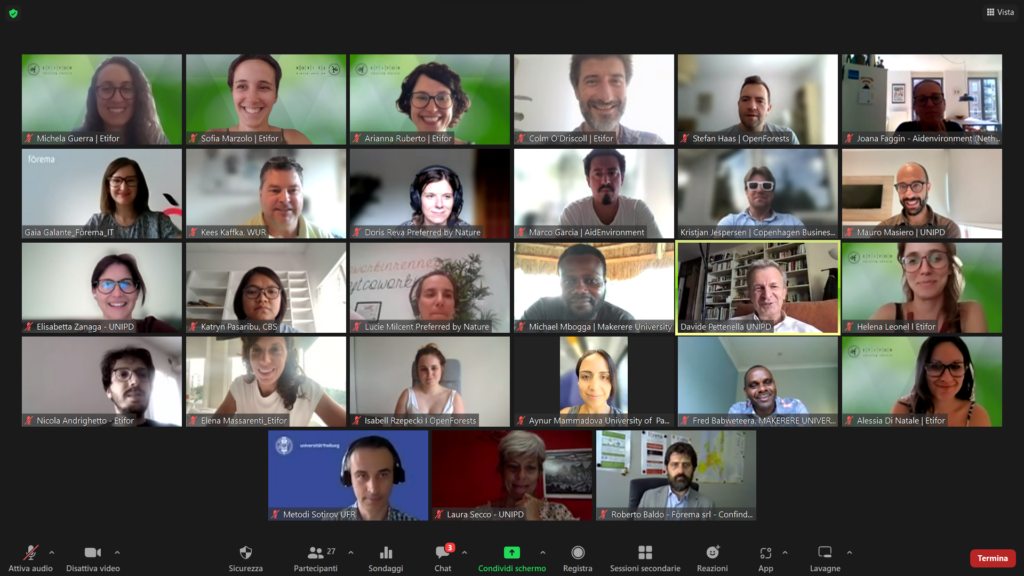
We are excited to be part of the EMMA4EU project, co-funded by the European Commission’s Erasmus+ Programme. The project aims to establish an EU alliance that will build capacity and skills for transitioning to deforestation-free supply chains. Our team’s focus will be on capacity-building related to mapping, GIS data analysis, and transparency.
Deforestation, driven primarily by the expansion of agricultural land, is a major contributor to climate change and biodiversity loss in tropical countries. Forest-risk commodities, such as cattle, wood, palm oil, soy, cocoa, coffee, and rubber are significant drivers, with the EU being the second-largest importer of commodity-driven deforestation.
Efforts to reduce commodity-driven deforestation face many challenges, such as lack of transparency, limited practical effectiveness, and conceptual difficulties regarding terminologies and definitions. Existing regulatory mechanisms are frequently fragmented and ineffective.

To overcome these challenges, the European Commission has recently published the Deforestation-free products Regulation (EUDR), which seeks to ban the imports to and exports from the EU of forest-risk commodities produced on deforested or degraded land after 2020. Still, there is a clear need to develop innovative ways for implementing the EUDR along supply chains.
The lack of comprehensive coverage of deforestation-related topics in national education and training curricula also challenges the path to a deforestation-free future. EMMA4EU aims to fill this gap by connecting different knowledge sectors, in an interdisciplinary approach.
The alliance will unite higher education institutions, vocational training organizations, businesses, public organizations, and NGOs to develop innovative training solutions and create new professional roles (Deforestation-Free Supply Chain Managers) that will support the implementation of the EUDR.
We are looking forward to some exciting years ahead together with Etifor, Università degli Studi di Padova, Wageningen University & Research, Preferred by Nature, Albert-Ludwigs-Universität Freiburg, Copenhagen Business School, AidEnvironment, Makerere University, and Fòrema.