
Key highlights
- Ecosystem services are the benefits people get from nature: food, clean water, a stable climate, pollinated crops and much more.
- Scientists group them into four types: provisioning, regulating, supporting and cultural services.
- 14 of the 18 categories of nature’s contributions to people assessed by IPBES have declined since 1970.
- Because markets don’t price them, these services are nearly invisible in balance sheets.
- Payments for ecosystem services and new disclosure frameworks are starting to put nature back in the numbers.
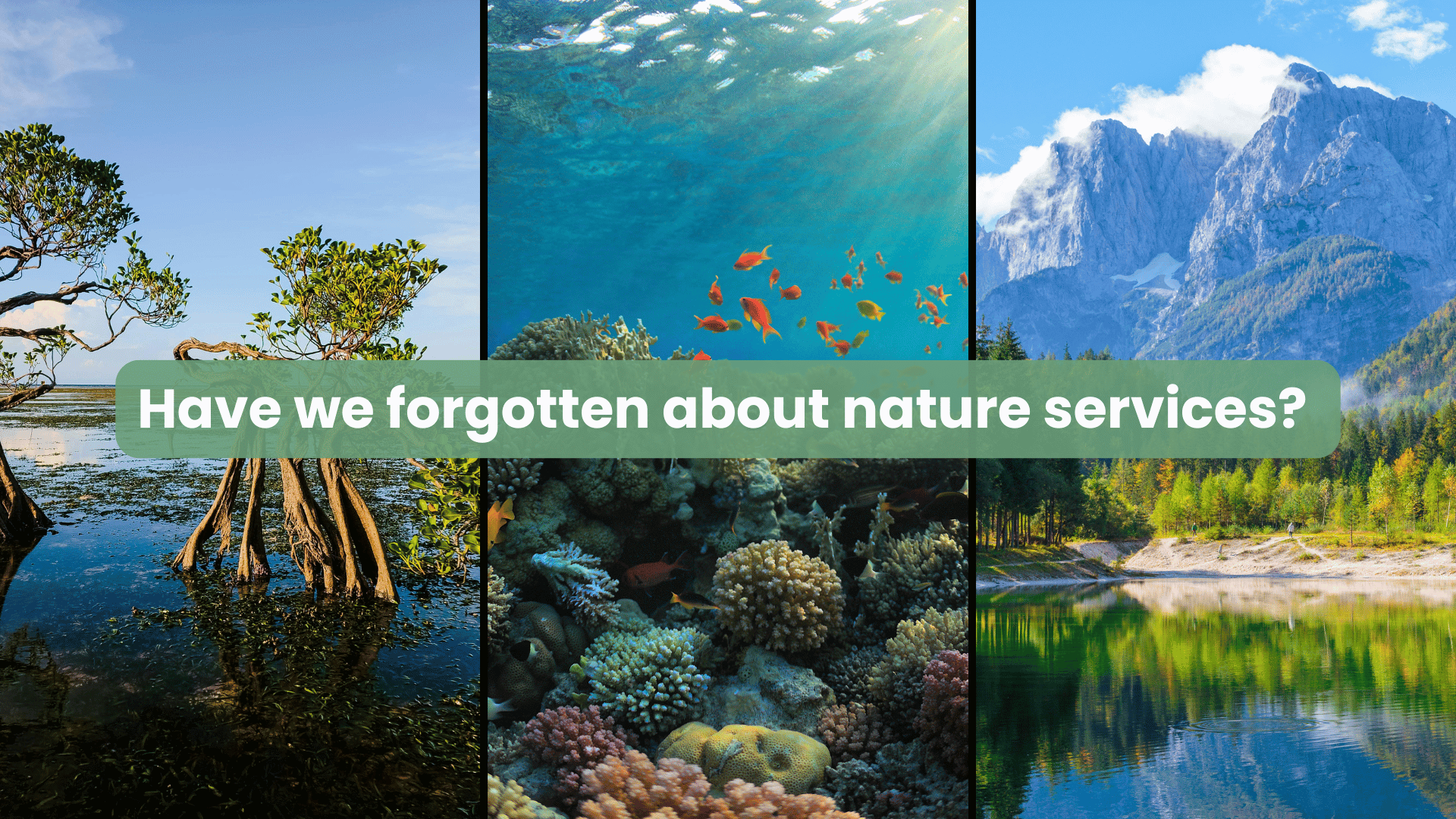
Have we forgotten what nature does for us?
Nature runs the largest service economy on Earth, and almost nobody pays the bill.
It cleans the water we drink. It pollinates the fruit and vegetables on our plates. Through ocean algae alone, it carries out roughly half of the planet’s photosynthesis, which keeps our air breathable1. We rarely think about any of this, because it arrives for free.
But “free” does not mean “guaranteed”. According to IPBES, 14 of the 18 categories of nature’s contributions to people have declined since 1970 2 3. The services are fading, and our economic system barely notices.
This article looks at what ecosystem services are, why our economy keeps forgetting them, and how they can find their way back into reports and financial strategies.
What are ecosystem services?
Before we can value nature’s work, we need to agree on what to call it, and three overlapping terms are in use today.
Ecosystem services meaning
Ecosystem services are the benefits people obtain from nature, from food and fresh water to climate regulation and recreation. This definition comes from the Millennium Ecosystem Assessment, the first global review of the world’s ecosystems 4.
In short: if nature does something that makes human life possible or better, it counts as an ecosystem service.
Nature services meaning: why some scientists now prefer “nature’s contributions to people”
Nature services is the plain-language equivalent of ecosystem services.
In 2018, scientists working with IPBES introduced a third term: nature’s contributions to people 5. The aim was to move beyond a purely economic view, in which nature is a supplier and humans are clients. The newer term also recognises the knowledge and values of Indigenous peoples and local communities.
For most readers, the three terms are interchangeable.
What are the four types of ecosystem services?
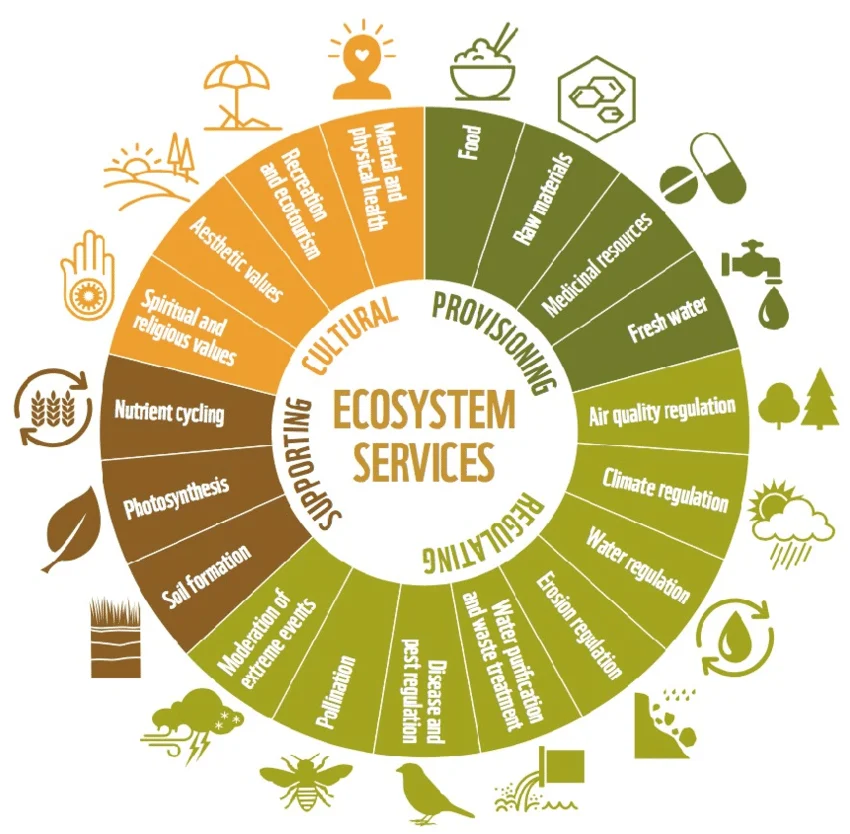
The Millennium Ecosystem Assessment groups ecosystem services into four types [4]:
| Type | What it does | Ecosystem services examples |
|---|---|---|
| Provisioning | Supplies goods we use directly | Food, fresh water, timber, fibre, medicinal plants |
| Regulating | Keeps environmental conditions stable | Climate regulation, flood control, pollination, water purification |
| Supporting | Underpins all other services | Soil formation, nutrient cycling, plant growth |
| Cultural | Enriches human life | Recreation, wellbeing, identity, spiritual values |
Provisioning services: food, water, timber, medicine
Ecosystem services provisioning covers everything we harvest from nature. These are the most visible services, because many of them are already sold on markets.
Regulating services: climate, floods, pollination, water purification
Ecosystem services regulating the environment work quietly in the background. Forests store carbon, wetlands buffer floods, and soils filter water.
Pollination shows how much is at stake: more than 75% of leading global food crop types benefit from animal pollinators, and up to US$577 billion of annual crop output is at risk from their decline 6.
Supporting services: soil formation, nutrient cycling, the base of everything else
Ecosystem services supporting life are the foundations: healthy soils, nutrient cycles, primary production. They don’t reach us directly, but every other service depends on them. Note that some recent classifications count them as ecosystem functions rather than services, to avoid double counting.
In short: to support ecosystem services as a whole, protect the processes underneath them.
Cultural services: wellbeing, identity, spirituality
Cultural services are the non-material benefits: a place to rest, a landscape that defines a community, a site of spiritual meaning. They are real, even when they resist measurement.
What happens when nature stops delivering?
The Millennium Ecosystem Assessment found that about 60% of the ecosystem services it examined were degraded or used unsustainably 4. Wetlands and coral reefs are two clear cases.
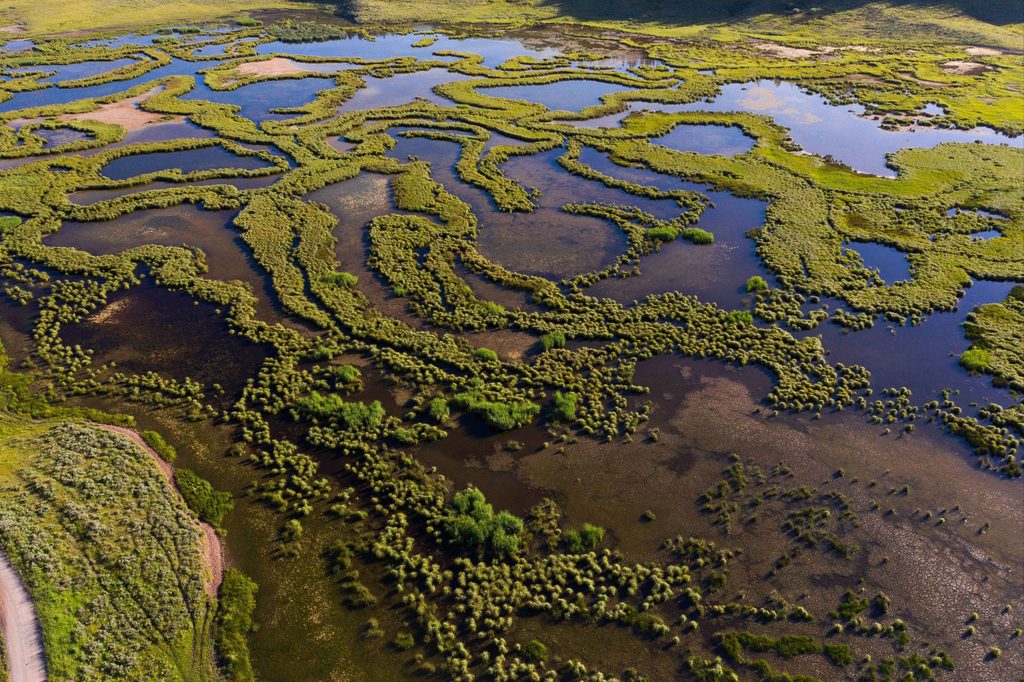
Wetlands: the disappearing water filters
Ecosystem services of wetlands include water purification, flood storage, groundwater recharge, carbon storage and habitat for fish and birds.
An estimated 64 to 71% of the world’s wetlands have disappeared since 1900, and the pace of loss sped up over the 20th century 7. Each loss means more polluted water and less protection against floods.
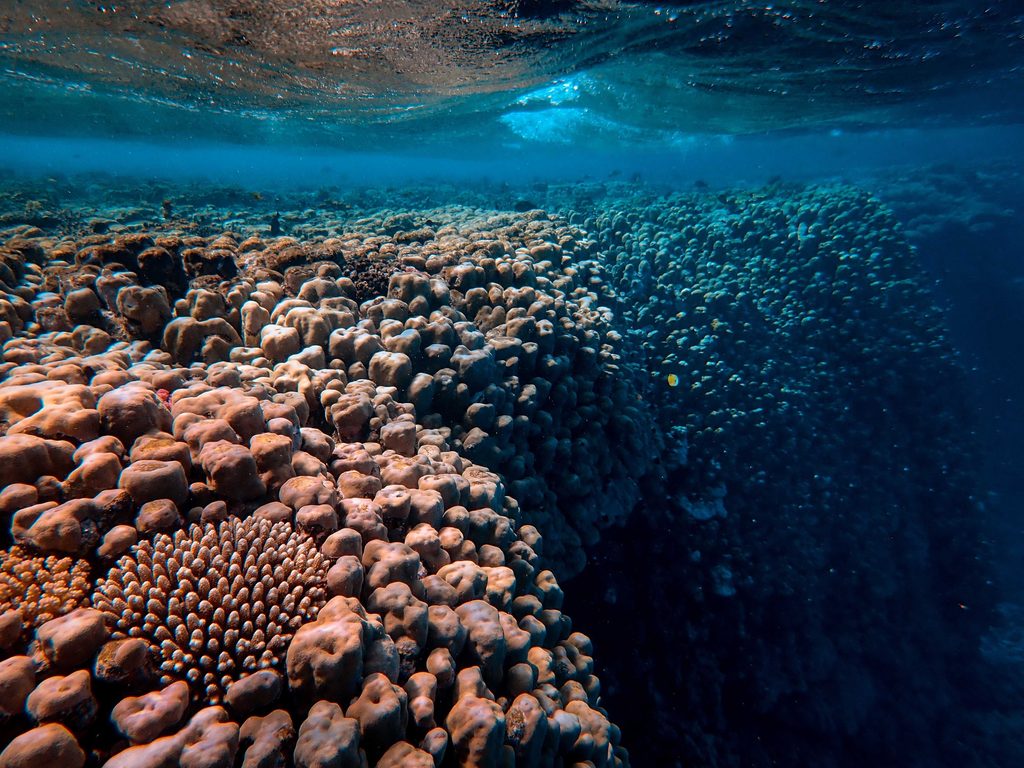
Coral reefs: the coastal shields we’re losing
Ecosystem services of coral reefs include fisheries, tourism, biodiversity and coastal protection. On average, reefs absorb 97% of incoming wave energy 8.
Without reefs, annual expected flood damage on coastlines would double, and damage from a once-in-a-century storm would rise by 91% to US$272 billion 9. Yet live coral cover has nearly halved over the last 150 years 2.
Primary forests: the services no plantation can replace
Primary forests, those never cleared by industrial activity, store more carbon, regulate water more reliably and shelter more species than any other type of forest 10. A review of 138 studies across the tropics concluded that they are irreplaceable for sustaining tropical biodiversity 11. Yet the tropics still lost 4.3 million hectares of them in 2025 12.
Why does the capitalist economy treat nature as free?
Ecosystem services are worth a great deal, yet they rarely show up in prices or company accounts, for two main reasons.
Externalities and the “free gift” problem
Our economy prices what can be owned and traded. Most ecosystem services are neither. When a company degrades a river or a forest, the cost falls on others: this is called an externality.
As a result, decisions are shaped by a narrow set of market values, while most of nature’s value stays off the books 13. When a service is free, nobody receives a warning when it starts to fail.
The limits of putting a price on nature
Researchers have tried to estimate the total value of ecosystem services. The first attempt arrived at US$33 trillion per year 14. The 2014 update raised it to US$125 to 145 trillion per year 15.
These estimates helped put nature on the economic agenda, but they have limits:
- Scaling local values to the whole planet is economically questionable, since the biosphere has no substitute and no buyer.
- Monetary figures can’t capture cultural, spiritual or relational values.
- A price may suggest that nature can be traded away, when many services are irreplaceable.
In short: valuation is a compass, not a price tag.

How do we bring nature services back into the balance sheet?
Two tools are helping nature move from the margins of the economy into its accounts: paying for ecosystem services, and requiring companies to report on them.
Payments for ecosystem services: promises and pitfalls
Payments for ecosystem services (PES) are voluntary agreements in which beneficiaries of a service pay land managers to maintain it, on agreed conditions 16. You may also see the phrase payments of ecosystem services.
Well-known examples include New York City’s investment in protecting the Catskills watershed instead of building a costly filtration plant 17 and Costa Rica’s national forest payment programme, running since 1997 18. Globally, more than 550 PES programmes move an estimated US$36 to 42 billion each year 19.
The pitfalls are real. Environmental results are often modest, and some schemes pay for forests that were never under threat 20. PES work best when the service is measured and monitored over time.
What reporting now asks of companies
- Kunming-Montreal Global Biodiversity Framework, Target 15 (2022): large companies and financial institutions should monitor, assess and disclose their biodiversity risks, dependencies and impacts 21.
- TNFD (2023): a voluntary framework for disclosing nature-related dependencies, impacts, risks and opportunities 22.
- CSRD and ESRS E4 (EU): a reporting standard on biodiversity and ecosystems, now limited by the 2026 Omnibus I directive to companies with more than 1,000 employees and €450 million in turnover 23.
- UN SEEA Ecosystem Accounting (2021): a statistical standard for including ecosystems in national accounts 24.
Every one of these frameworks depends on reliable, site-level data about the state of ecosystems.
Making nature’s value visible
Recognising the value of ecosystem services is one thing. Understanding how they change over time, and whether conservation and restoration efforts are making a difference, is another.
At OpenForests, we work with organisations to turn environmental data into meaningful insights. By combining geospatial monitoring, impact measurement and interactive tools, we help make changes in ecosystems visible, understandable and accessible to the people making decisions.
Explore our approach to impact monitoring→
References
- Field, C. B., Behrenfeld, M. J., Randerson, J. T., & Falkowski, P. (1998). Primary production of the biosphere: integrating terrestrial and oceanic components. Science, 281(5374), 237-240. https://doi.org/10.1126/science.281.5374.237 ↩︎
- IPBES (2019). Global Assessment Report on Biodiversity and Ecosystem Services. IPBES Secretariat, Bonn. ↩︎
- Díaz, S., Settele, J., Brondízio, E. S., et al. (2019). Pervasive human-driven decline of life on Earth points to the need for transformative change. Science, 366(6471), eaax3100. https://doi.org/10.1126/science.aax3100 ↩︎
- Millennium Ecosystem Assessment (2005). Ecosystems and Human Well-being: Synthesis. Island Press, Washington, DC. ↩︎
- Díaz, S., Pascual, U., Stenseke, M., et al. (2018). Assessing nature’s contributions to people. Science, 359(6373), 270-272. https://doi.org/10.1126/science.aap8826 ↩︎
- IPBES (2016). The Assessment Report on Pollinators, Pollination and Food Production. Potts, S. G., Imperatriz-Fonseca, V. L., & Ngo, H. T. (eds.). IPBES Secretariat, Bonn. ↩︎
- Davidson, N. C. (2014). How much wetland has the world lost? Long-term and recent trends in global wetland area. Marine and Freshwater Research, 65(10), 934-941. https://doi.org/10.1071/MF14173 ↩︎
- Ferrario, F., Beck, M. W., Storlazzi, C. D., Micheli, F., Shepard, C. C., & Airoldi, L. (2014). The effectiveness of coral reefs for coastal hazard risk reduction and adaptation. Nature Communications, 5, 3794. https://doi.org/10.1038/ncomms4794 ↩︎
- Beck, M. W., Losada, I. J., Menéndez, P., Reguero, B. G., Díaz-Simal, P., & Fernández, F. (2018). The global flood protection savings provided by coral reefs. Nature Communications, 9, 2186. https://doi.org/10.1038/s41467-018-04568-z ↩︎
- Watson, J. E. M., et al. (2018). The exceptional value of intact forest ecosystems. Nature Ecology & Evolution, 2, 599-610. https://doi.org/10.1038/s41559-018-0490-x ↩︎
- Gibson, L., et al. (2011). Primary forests are irreplaceable for sustaining tropical biodiversity. Nature, 478, 378-381. https://doi.org/10.1038/nature10425 ↩︎
- University of Maryland GLAD Lab & World Resources Institute (2026). Tropical primary forest loss data 2025, Global Forest Watch. Method: Turubanova, S., et al. (2018). Environmental Research Letters, 13, 074028.
↩︎ - IPBES (2022). Methodological Assessment Report on the Diverse Values and Valuation of Nature. IPBES Secretariat, Bonn. ↩︎
- Costanza, R., d’Arge, R., de Groot, R., et al. (1997). The value of the world’s ecosystem services and natural capital. Nature, 387, 253-260. https://doi.org/10.1038/387253a0 ↩︎
- Costanza, R., de Groot, R., Sutton, P., et al. (2014). Changes in the global value of ecosystem services. Global Environmental Change, 26, 152-158. https://doi.org/10.1016/j.gloenvcha.2014.04.002 ↩︎
- Wunder, S. (2015). Revisiting the concept of payments for environmental services. Ecological Economics, 117, 234-243. https://doi.org/10.1016/j.ecolecon.2014.08.016 ↩︎
- Chichilnisky, G., & Heal, G. (1998). Economic returns from the biosphere. Nature, 391, 629-630. https://doi.org/10.1038/35481 ↩︎
- Pagiola, S. (2008). Payments for environmental services in Costa Rica. Ecological Economics, 65(4), 712-724. https://doi.org/10.1016/j.ecolecon.2007.07.033 ↩︎
- Salzman, J., Bennett, G., Carroll, N., Goldstein, A., & Jenkins, M. (2018). The global status and trends of Payments for Ecosystem Services. Nature Sustainability, 1, 136-144. https://doi.org/10.1038/s41893-018-0033-0 ↩︎
- Börner, J., Baylis, K., Corbera, E., et al. (2017). The effectiveness of payments for environmental services. World Development, 96, 359-374. https://doi.org/10.1016/j.worlddev.2017.03.020 ↩︎
- Convention on Biological Diversity (2022). Kunming-Montreal Global Biodiversity Framework (Decision 15/4). ↩︎
- Taskforce on Nature-related Financial Disclosures (2023). Recommendations of the Taskforce on Nature-related Financial Disclosures. ↩︎
- European Parliament and Council of the European Union (2026). Directive (EU) 2026/470 (Omnibus I) amending the Corporate Sustainability Reporting Directive. Official Journal of the European Union, 26 February 2026. ↩︎
- United Nations et al. (2021). System of Environmental-Economic Accounting: Ecosystem Accounting (SEEA EA). United Nations, New York. ↩︎